
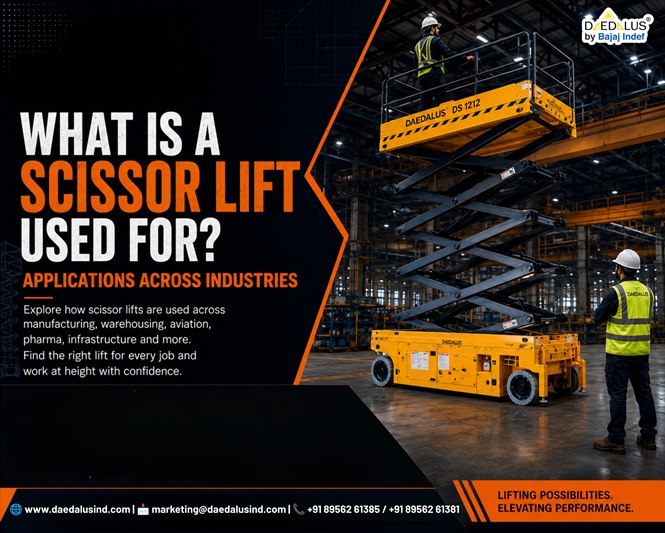
Scissor lifts are battery-powered elevating platforms used across industries including manufacturing, warehousing, aviation, pharma, and infrastructure to safely reach heights of 6m to 20m. They replace unsafe makeshift scaffolding and reduce working-at-height risks under Indian regulations. This guide covers the core applications, which lift type suits each job, and how to match the right platform to your worksite requirements.
The Problem Most Worksites Face at Height
Picture this. A maintenance supervisor at a large auto plant needs to replace overhead lighting fixtures at 9 metres. The scaffolding contractor asks for two days to set up. The safety officer flags the bamboo platform as non-compliant. And the production line is already behind schedule.
This is the exact problem a scissor lift is built to solve.
Scissor lift uses span nearly every industry in India today. From warehouses and pharmaceutical cleanrooms to aviation hangars and railway yards, these electric platforms get your team to height safely, quickly, and without the hassle of scaffolding. Yet many buyers still don't know which type fits their specific site.
This guide breaks down the real-world applications of scissor lifts, explains which platform suits which job, and helps you make a confident decision before you buy or rent.
What Is a Scissor Lift and How Does It Work?
A scissor lift is a mobile elevating work platform (MEWP) that uses a crisscrossing metal support structure to raise an operator and their tools vertically to working heights between 6m and 20m. Battery-powered models produce zero emissions, making them safe for indoor use on flat slab surfaces.
The name comes from the linked scissor-like supports that extend upward as hydraulic pressure is applied. The result is a stable, level platform that rises straight up without tilting.
Unlike ladders or scaffolding, a scissor lift gives the operator a full working platform with guardrails. That means both hands are free to work, tools can sit on the platform, and there is no risk of overreaching.
Daedalus scissor lifts add a further layer of safety through the Daedalus Intelligent Vehicle Control System (DIVCS). This in-house-designed system provides real-time fault detection and easy diagnostics, which reduces downtime on busy worksites.
All Daedalus platforms are certified to EN 280, the European standard for mobile elevating work platforms. This certification sets the global benchmark for MEWP design, load capacity, and safety.
Scissor Lift Applications in Manufacturing and Automotive Plants
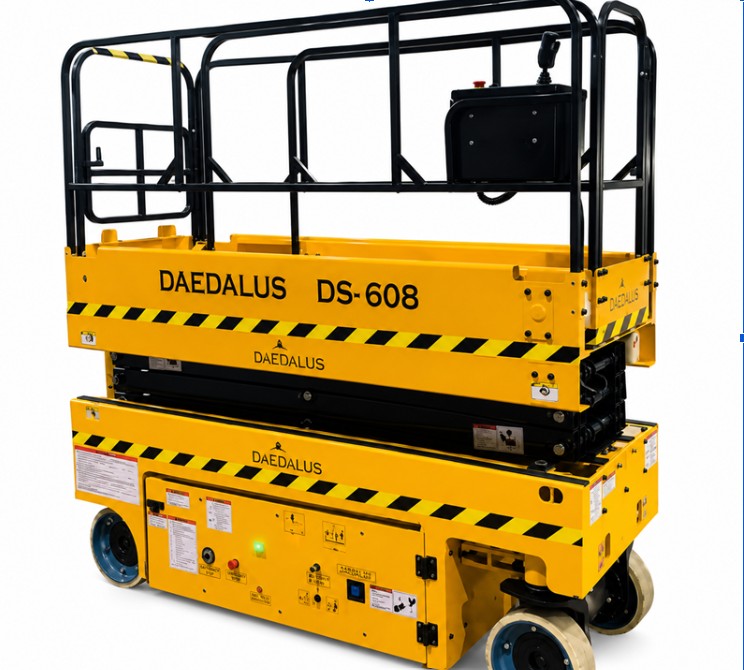
The manufacturing sector is one of the largest users of scissor lifts in India. The reasons are straightforward: factories have high ceilings, flat floors, and constant maintenance needs.
Common tasks in manufacturing:
- Replacing overhead lighting along production lines at 8m to 12m
- Maintaining or installing conveyor systems and overhead cranes
- Painting and inspection of high ceiling structures
- Cabling and electrical work in assembly areas
- Accessing mezzanine levels for equipment servicing
Auto plants have particularly tight spaces between production lines. The proportional drive system on Daedalus self-propelled scissor lifts lets operators manoeuvre slowly and precisely in compact aisles. There is no jerky acceleration that could damage nearby components or put the operator at risk.
Automotive leaders across India, including facilities supporting aviation MRO at HAL, use Daedalus platforms for precision access tasks where both height accuracy and platform stability are non-negotiable.
For indoor manufacturing environments on flat slab surfaces, the DS-808 to DS-1412 self-propelled slab scissor lift range is the natural fit, with platform capacities of 350 kg and working heights up to 14m.
How Are Scissor Lifts Used in Warehouses and Logistics Hubs?
In warehouses and logistics facilities, scissor lifts are used to install and maintain high-bay racking systems, replace lighting at 8m to 12m, and access inventory in areas a forklift cannot safely reach. Electric models are preferred because they produce zero fumes and operate quietly on busy floors.
High-bay warehouses are a perfect use case for scissor lifts. Racking systems reach 10m or more. Lighting failures happen regularly. And a forklift with a man-basket is neither safe nor productive for work that needs both hands free at height.
A scissor lift parks under the work area, raises the operator to the exact height needed, and stays stable until the job is done. The electromagnetic brakes ensure the platform doesn't shift during work, even if the operator needs to lean or push against a fixed surface.
Warehouse tasks suited to scissor lifts:
- High-bay lighting installation and replacement
- HVAC duct installation and servicing
- Racking system assembly, repair, and labelling
- CCTV and fire suppression system installation
- Inventory audits at upper rack levels
Many warehouse managers ask whether a scissor lift or a forklift is better for height access. The answer is clear when the task involves a person working at height: scissor lifts provide a guarded platform purpose-built for the job. Forklifts are designed to move loads, not people.
For warehouses with smooth concrete floors and ceiling heights up to 14m, the Daedalus DS-1010 and DS-1212 are well-suited options.
Scissor Lift Uses in Infrastructure, Construction, and Renovation
Construction and infrastructure sites have a different set of challenges. Floors are rarely flat. Ground conditions change between project phases. And work often happens outdoors where wind and terrain add risk.
This is where rough terrain scissor lifts come into their own. Unlike standard slab models, these platforms are built with larger wheels, higher ground clearance, and four-wheel drive to handle uneven surfaces safely.
Construction and infrastructure applications:
- Façade painting and cladding installation on commercial buildings
- False ceiling installation and MEP (mechanical, electrical, plumbing) work
- Bridge and flyover inspection and maintenance
- Airport and railway infrastructure servicing
- Stadium and large venue interior finishing
India's Building and Other Construction Workers Act (BOCW) 1996 requires employers to provide safe access for workers at height. Using a CE-certified rough terrain scissor lift is a clear way to meet that obligation, especially during project safety audits.
Daedalus offers three rough terrain models: the DS-1218RT, DS-1418RT, and DS-1618RT, with working heights from 12m to 16m and the stability to operate on compacted uneven ground.
Specialized Applications: Aviation, Pharma, and Space Research
In aviation hangars, scissor lifts access aircraft fuselage, engine nacelles, and wing surfaces at heights above 8m. In pharmaceutical cleanrooms, electric platforms produce no emissions that could contaminate controlled environments. In space research facilities, precision access at height is critical to the work itself.
These three sectors share a common requirement: zero tolerance for error at height. That makes platform stability, certified safety systems, and clean operation non-negotiable.
Aviation MRO (Maintenance, Repair and Overhaul)
Aircraft servicing requires access to fuselage sections, engines, and tail assemblies at varying heights. Scissor lifts provide stable, adjustable platforms that can be repositioned quickly around the aircraft without the setup time of fixed scaffolding. Daedalus platforms are trusted by aviation sector clients including HAL for exactly this reason.
Pharmaceutical Manufacturing
GMP-certified cleanrooms require equipment that produces no fumes, minimal dust, and low noise. Battery-electric scissor lifts meet all three requirements. They are used for equipment installation, HVAC maintenance, and facility fit-out in pharma plants across India.
Space Research Facilities
ISRO facilities demand absolute precision in every task. Daedalus platforms have been used in space research environments where accessing large structures at height requires both the stability of a scissor lift and the reliability of a certified control system. The DIVCS onboard system makes fault identification instant, so there is no unexpected downtime during critical operations.
Which Type of Scissor Lift Matches Your Application?
The right scissor lift depends on three factors: the surface you are working on (flat slab or rough terrain), the working height you need (6m to 20m), and whether the machine needs to move on its own or can be pushed manually. Getting this match right prevents under-specification and avoids safety risks.
Here is a quick reference to match your worksite to the right Daedalus platform:
| Use Case | Surface | Height Range | Recommended Model |
| Warehouse / factory indoor | Flat slab | 6m – 14m | DS-608 to DS-1412 (Self-Propelled) |
| Light-duty indoor tasks | Flat slab | 6m – 12m | DS-608_M_AC to DS-1212_M_AC (Pushable) |
| Construction / outdoor | Uneven / rough | 12m – 16m | DS-1218RT / DS-1418RT / DS-1618RT |
| Narrow indoor spaces | Flat slab | 8m – 10m | JIB Master 8M or 10M |
| Overhead work with reach | Flat slab | 12m – 20m | DBA Articulating Boom Lift range |
A few things to verify before you finalise:
- Check the floor surface: polished concrete, rough ground, or something in between?
- Confirm your minimum working height and add 1m for safe overhead clearance
- Verify door width if the machine needs to move between bays or floors
- Check platform weight capacity against your tools and personnel load
- Ask for CE certification documentation (EN 280) from any supplier before purchase
If you are unsure, Daedalus engineers can help you shortlist the right model based on your actual site requirements.
Regulatory and Safety Considerations for Scissor Lift Use in India
Working at height is one of the leading causes of fatal workplace accidents in India. The regulatory framework exists to prevent this, and using certified equipment is the clearest way to demonstrate compliance.
Key regulations to know:
- Factories Act 1948: Requires employers to ensure safe access for workers operating at height in industrial facilities
- BOCW Act 1996: Mandates safe working platforms and fall protection on all construction sites
- IS 7293: Indian Standard covering the safety requirements for aerial work platforms
- CEA Regulations 2023: Covers electrical safety for battery-powered equipment, including MEWPs
- ISO 45001: International occupational health and safety management standard aligned with MEWP best practices
CE certification to EN 280 is the product-level standard that confirms a scissor lift has been designed, tested, and built to meet these safety requirements. When procuring a scissor lift for your facility, always request the EN 280 CE certificate for the specific model. A company-level claim is not the same as a product-level certification.
IPAF (International Powered Access Federation) guidance also recommends formal operator training before using any MEWP. Trained operators reduce both accident risk and equipment damage.
Daedalus products are designed and manufactured to EN 280 standards. The DIVCS control system supports safe operations by flagging faults before they become hazards, and the inbuilt smart battery charger includes overcharge protection to prevent electrical incidents during charging.
Conclusion: Match the Right Platform to Your Worksite
Scissor lifts are one of the most versatile working-at-height solutions available. Whether your team is replacing warehouse lighting, finishing a construction façade, servicing aircraft, or maintaining cleanroom equipment, there is a platform built for the job.
The key is matching the lift type to your actual requirements: surface condition, working height, load capacity, and regulatory compliance. Getting that match right saves money, reduces risk, and keeps your team productive.
Daedalus offers 21 MEWP models across five categories, all manufactured in Pune to CE (EN 280) standards, with 85% Indian-sourced components and a pan-India service network to support you after delivery.
|
Not Sure Which Scissor Lift Fits Your Worksite? Tell us your worksite details and our engineers will recommend the right model. All Daedalus platforms are CE-certified to EN 280 and backed by a pan-India service network. Call / WhatsApp: +91 8956261385 Email: sales@daedalusind.com Browse our full range at daedalusind.com |
Frequently Asked Questions
What is the maximum working height of a scissor lift used in Indian industries?
Daedalus scissor lifts cover working heights from 6m (DS-608) up to 16m for rough terrain models (DS-1618RT). The articulating boom lift range extends this further to 20m for applications requiring greater reach. The right model depends on your specific ceiling height or work level, with a recommended 1m safety margin above the minimum required height.
Can scissor lifts be used outdoors on uneven or rough terrain?
Yes, but only with a rough terrain-specific model. Standard slab scissor lifts are designed for smooth, flat indoor surfaces. Daedalus rough terrain models (DS-1218RT, DS-1418RT, DS-1618RT) are built with larger tyres, four-wheel drive, and higher ground clearance for compacted outdoor surfaces. Using a slab model on rough ground is a safety violation and will likely damage the machine.
What is the load capacity of a standard scissor lift platform?
Daedalus self-propelled slab scissor lifts have a platform load capacity of 350 kg. This typically supports two operators with tools. Always check the specific model's rated capacity before loading the platform, and never exceed it. Platform overloading is one of the most common causes of MEWP incidents on Indian worksites.
What certifications should I look for when buying a scissor lift in India?
The primary certification to look for is CE certification to EN 280, which is the international standard for MEWP design and safety. This must be a product-level certificate for the specific model, not a general company-level claim. Also check that the equipment complies with the CEA Regulations 2023 for electrical safety and that the supplier can provide documentation for regulatory audits.
What is the difference between a self-propelled scissor lift and a push-able scissor lift?
A self-propelled scissor lift has an electric drive system. The operator can move the machine while seated at ground level or from the platform. A push-able (manual) scissor lift has no drive motor. It is positioned manually and then elevated. Self-propelled models are better for large or frequently-changing worksites. Push-able models are lower cost and suited to fixed or light-duty indoor tasks where the machine stays in one area.
