
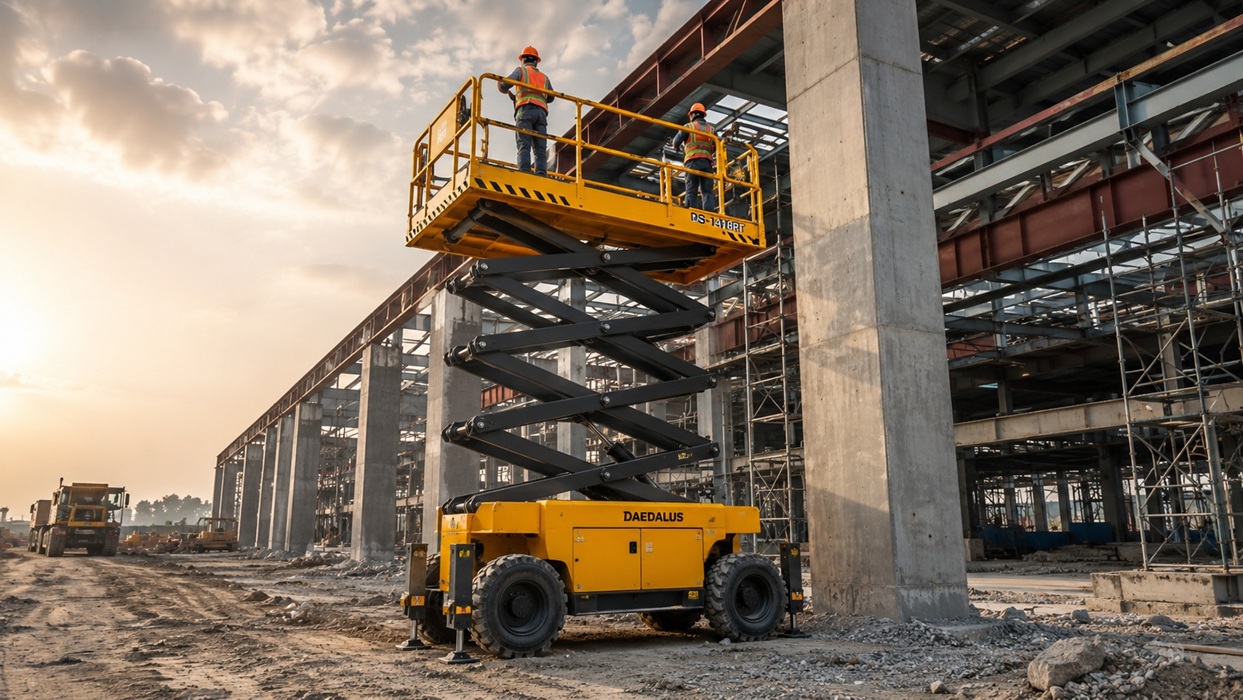
A rough terrain scissor lift is a self-propelled, battery-powered work platform built for outdoor sites with uneven or challenging ground. It's used across construction, infrastructure, industrial, and aviation sectors where standard scissor lifts would be unsafe. This guide covers every major application, the key features that matter, and how to choose the right model for your project.
You've got a project running outdoors. The ground is uneven. There are tools, materials, and a team that needs to work safely at height. You bring in a standard scissor lift, and within minutes you realise the problem: it wobbles, it won't level properly, and your supervisor calls a stop.
This is one of the most common and costly mistakes on outdoor worksites in India. The wrong access equipment doesn't just slow you down. It creates serious safety risks and drives up costs.
That's where a rough terrain scissor lift solves the problem. It's built specifically for the kind of ground conditions that defeat standard machines. In this guide, we'll cover what it is, where it's used, what features to look for, and how to choose the right model for your site.
What Is a Rough Terrain Scissor Lift?
A rough terrain scissor lift is a self-propelled, battery-powered elevated work platform designed for outdoor use on uneven, soft, or challenging ground. It features high ground clearance, a robust drive system, automatic self-levelling stabilizers, and a spacious platform to keep workers safe and productive on demanding sites.
This is different from a standard indoor slab scissor lift. Indoor machines are built for level, hard floors. Rough terrain models are engineered for exactly the opposite: construction sites, unpaved surfaces, outdoor industrial yards, and anywhere the ground is far from perfect.
Daedalus Rough Terrain Scissor Lifts — the DS-1218RT, DS-1418RT, and DS-1618RT — offer working heights from 12 metres to 16 metres. They're self-propelled and battery-powered, which means no emissions and low operating costs on site.
Where Are Rough Terrain Scissor Lifts Commonly Used?
Rough terrain scissor lifts are used wherever workers need to reach height safely on outdoor or uneven surfaces. The most common sectors include construction sites, infrastructure projects, industrial plants, warehouses, aviation facilities, railways, pharmaceutical manufacturing plants, and large outdoor maintenance operations.
Here's what that looks like in practice:
Construction and infrastructure: Structural work, facade maintenance, and installation tasks on active construction sites where the ground is rarely level and changes daily.
Industrial plants: Maintenance of overhead equipment, lighting, pipework, and structural inspections in large outdoor or semi-covered industrial facilities.
Aviation facilities: Airside maintenance work where large outdoor aprons and hangars demand stable, high-reach access equipment.
Railways: Track-side maintenance and overhead infrastructure work where ground conditions are variable and safety margins are critical.
Warehouses and logistics parks: Larger outdoor facilities with loading areas, rooftops, and yard infrastructure that standard indoor lifts can't safely access.
Pharmaceuticals and manufacturing: Facilities with outdoor plant areas, utility installations, and large rooftop equipment requiring periodic maintenance at height.
If your site has any of these conditions, a rough terrain machine is almost certainly the right tool.
Rough Terrain vs. Standard Scissor Lift: Which One Do You Need?
If your site has level, hard flooring indoors, a standard self-propelled scissor lift is the right choice. If your site has uneven ground, outdoor exposure, or heavy loads on soft or unpaved surfaces, you need a rough terrain scissor lift.
Here's a simple way to decide:
If you're not sure which type suits your application, it's worth speaking with an expert. Getting this wrong is expensive.
Key Features That Make Rough Terrain Scissor Lifts Safe and Productive
Features matter more than specs on a rough terrain machine. Here's what to look for and why each one exists:
Automatic self-levelling stabilizers keep the platform level even when the ground beneath the machine isn't. On a construction site, this is non-negotiable.
Electromagnetic brakes lock the machine in place during operation. They engage automatically and don't rely on the operator to remember to activate them.
Tilt sensors monitor the machine's angle in real time. If the machine goes beyond a safe tilt angle, they trigger a warning or stop operation entirely.
Overload indicators alert the operator when the platform load exceeds the safe working limit. This prevents accidents caused by overloading, which is one of the most common causes of scissor lift incidents.
Proportional drive controls let the operator make fine, precise movements in tight or congested spaces. This is especially useful on busy construction sites where other equipment and workers are nearby.
Daedalus machines also feature the Daedalus Intelligent Vehicle Control System, which is designed and developed in-house. It provides easy fault detection and real-time diagnostics, so your team can identify and resolve issues on site without waiting for an external technician. This directly reduces downtime and keeps your project on schedule.
What Working Heights and Load Capacities Are Available?
The Daedalus Rough Terrain Scissor Lift range covers working heights from 12 metres to 16 metres across three models:
-
DS-1218RT: 12-metre working height
-
DS-1418RT: 14-metre working height
-
DS-1618RT: 16-metre working height
All three models feature spacious platforms with extension decks, allowing operators to carry tools, materials, and in most cases work as a crew rather than a single operator. This reduces the number of lifts needed per task and improves overall site productivity.
For applications that need greater reach or outreach beyond a scissor lift's vertical capability, Daedalus articulating boom lifts (DBA-12-6 through DBA-20-11) offer working heights up to 20 metres with horizontal outreach.
Why Indian Worksites Are Switching to Rough Terrain MEWPs
Traditional access methods on Indian outdoor sites, such as bamboo scaffolding and improvised ladders, create real productivity and safety problems. They're slow to set up, difficult to reposition, and carry significant risk when workers are operating at height with tools and materials.
Rough terrain scissor lifts solve all three problems. They're fast to deploy, easy to move between positions, and designed to meet stringent safety standards.
Daedalus is an original design manufacturer (ODM) of MEWPs based in Talawade, Pune. Every Daedalus product is designed and manufactured in India, with 85% of components sourced locally. All products are built to EN 280 (CE) standards, the internationally recognised benchmark for elevated work platform safety.
For Indian buyers, this matters for two reasons. First, CE certification means the machine meets global safety standards, not just minimum local requirements. Second, local manufacturing and an 85% Indian components base means faster spare parts availability, lower maintenance costs, and a genuine pan-India service network to support your operations.
If you're comparing options, these are the factors that determine total cost of ownership, not just the purchase price.
How to Choose the Right Rough Terrain Scissor Lift for Your Project
The right rough terrain scissor lift depends on four things: working height, platform load, ground conditions, and service support in your region.
Ask yourself these questions before you decide:
-
What's the maximum height I need to reach? (Choose a model with a working height at least 1-2 metres above your task height.)
-
How many workers and how much equipment will be on the platform at once?
-
How rough or uneven is my site ground?
-
Do I need the machine to travel significant distances on site between tasks?
-
Is there a local service team available if I need support?
If you need vertical reach only, a rough terrain scissor lift is ideal. If you need to reach over obstacles or work at an angle, an articulating boom lift or the JIB Master vertical mast lift may be a better fit.
The Right Equipment Makes the Difference
Choosing the right access equipment for your outdoor worksite isn't just a procurement decision. It's a safety and productivity decision that affects every day your project runs.
Rough terrain scissor lifts are purpose-built for the conditions that defeat standard machines. With the right model, your team works safely, moves faster, and finishes the job with fewer complications.
Daedalus manufactures CE-certified rough terrain scissor lifts in India, backed by a pan-India service network and the Daedalus Intelligent Vehicle Control System for on-site diagnostics.
Speak with our team to get a model recommendation for your specific site and application.
Call us on +91 8956261385 or email sales@daedalusind.com and we'll help you select the right machine.
Frequently Asked Questions
1. What is the difference between a rough terrain scissor lift and a slab scissor lift?
A slab scissor lift is designed for level, hard indoor surfaces such as warehouse floors and factory interiors. A rough terrain scissor lift is designed for outdoor or uneven ground. It features higher ground clearance, a heavy-duty drive system, and automatic self-levelling stabilizers that keep the platform safe on challenging surfaces.
2. Can rough terrain scissor lifts be used indoors?
Rough terrain scissor lifts are primarily designed for outdoor and uneven terrain. While they can physically fit in large indoor spaces, they're larger and heavier than standard indoor scissor lifts. For indoor applications on level surfaces, a standard self-propelled slab scissor lift is a better and more cost-effective choice.
3. What working heights do Daedalus rough terrain scissor lifts offer?
Daedalus offers three rough terrain models: the DS-1218RT (12m), DS-1418RT (14m), and DS-1618RT (16m). All three are battery-powered, self-propelled, and built to EN 280 (CE) standards for safe operation on outdoor and uneven worksites.
4. Are Daedalus rough terrain scissor lifts battery powered?
Yes. All Daedalus rough terrain slab scissor lifts are battery-powered and produce zero emissions during operation. This makes them suitable for both outdoor sites and environmentally sensitive project areas, while keeping operating costs low compared to diesel alternatives.
5. What safety features should I look for in a rough terrain scissor lift?
The key safety features to look for are: automatic self-levelling stabilizers, electromagnetic brakes, tilt sensors, overload indicators, and proportional drive controls. Daedalus rough terrain scissor lifts include all of these, along with the Daedalus Intelligent Vehicle Control System for real-time fault detection and diagnostics on site.
