
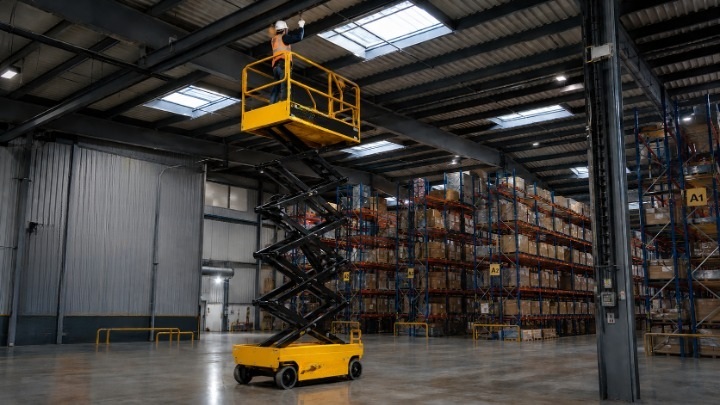
Aerial work platforms (AWPs) are replacing ladders and scaffolding across Indian warehouses, factories, and industrial facilities. From racking installation in e-commerce fulfilment centres to overhead maintenance in automobile plants, the right MEWP saves time, reduces fall risk, and lowers operating costs. This guide covers 10 real-world AWP applications in Indian industry, the right machine type for each, and how Daedalus's CE-certified, Make-in-India scissor and boom lifts support every one of them.
Your team needs to reach 10 metres. The bamboo scaffolding takes half a day to erect. By the time it's up, half your shift is gone — and you still have the teardown to think about.
This is the daily reality for thousands of maintenance supervisors, facility managers, and plant engineers across India. Work at height is unavoidable. But the way most Indian facilities handle it hasn't changed in decades.
That's changing fast. The India aerial work platform market reached USD 0.90 billion in 2024 and is projected to hit USD 1.50 billion by 2033. Indian businesses, from e-commerce warehouses in Pune to automobile plants in Chennai, are switching to aerial work platforms (AWPs) because they simply get the job done faster and safer.
At Daedalus, we've worked with clients across Indian Railways, ISRO, Aditya Birla, and Siemens. We've seen firsthand which applications demand which machine. Here are the 10 most common and important ones.
1. Warehouse Racking Installation and Stock Picking
Self-propelled electric scissor lifts are the go-to aerial work platform for Indian warehouses. They let your team install high-bay racking, pick stock from upper levels, and carry out bin labelling at heights of 6 to 14 metres, all on smooth concrete floors, without any scaffolding setup time.
India's warehousing sector is growing at a pace few industries can match. The rise of e-commerce players like Amazon, Flipkart, and Reliance Retail has pushed large-scale warehouse construction into Tier I and Tier II cities. Modern fulfilment centres now use scissor lifts as standard equipment for maintenance, racking, and inventory operations.
The reason is practical. A scissor lift platform is large enough for two workers plus tools and materials. That means the whole team works together at height, instead of one person clinging to a ladder while another waits below.
Our self-propelled scissor lift range (DS-608 to DS-1412) is built specifically for smooth indoor floors. Battery-powered, quiet, and zero-emission, they're ideal for warehouses where forklifts and people share the same space.
2. HVAC, Electrical, and Ceiling Maintenance
Every factory and commercial building in India has a ceiling full of systems that need regular attention: HVAC ducts, conduit runs, sprinkler heads, light fittings, and fire alarm sensors. Reaching them safely is one of the most common AWP use cases across the country.
Common mast and scissor lift applications include indoor lighting service, signage installation, ceiling cleaning, and sprinkler head inspection. For most of these tasks, a pushable scissor lift or compact self-propelled unit does the job perfectly.
The key advantage is speed. Scaffolding erection for a ceiling-level task can eat two to three hours before a single tool is raised. A pushable scissor lift is in position and elevated in minutes.
Our pushable scissor lifts (DS-608_M_AC to DS-1212_M_AC, plus the DS-706AC) are lightweight, easy to manoeuvre in tight aisles, and require no operator driving licence. They're the most accessible entry point into safe work at height for Indian facilities teams.
3. Automobile and Heavy Manufacturing Assembly Lines
India's automobile manufacturing corridor, stretching through Pune, Nashik, Chennai, and Gurugram, runs some of the most demanding factory environments in the country. Assembly lines need workers elevated at precise heights for welding, body-in-white operations, and overhead component installation.
Fixed scaffolding doesn't work here. It blocks line movement and creates delays every time the task location changes. A self-propelled scissor lift solves both problems. It moves when the task moves, and the platform stays stable while workers operate at height.
We've worked with clients in the Aditya Birla and Siemens ecosystem on exactly these kinds of requirements. The DS-1010 and DS-1212 models handle the load capacity and platform size demands of assembly-line environments with ease.
4. What AWP Works Best in Pharma and Food Processing Plants?
In Indian pharmaceutical and food processing plants, the aerial work platform must be electric, quiet, and clean. Self-propelled slab scissor lifts with non-marking tyres are the right choice. They're used for pipe maintenance, equipment inspection, and HVAC access inside GMP-compliant environments where emissions and noise are unacceptable.
India's pharma manufacturing belt (Pune, Hyderabad, Ahmedabad) runs under strict Good Manufacturing Practice (GMP) guidelines. Any equipment operating inside a production facility must not contaminate the environment. Battery-operated lifts produce zero emissions and minimal noise, making them the only viable option in these spaces.
CE certification matters here too. It's not just a badge. Our products are fully designed and manufactured to EN 280 standards. That alignment with European safety norms gives pharma plant managers the compliance documentation they need when auditors walk through.
5. Outdoor Construction Sites and Rough Terrain Applications
Not every worksite has a smooth concrete floor. Construction sites, outdoor industrial yards, and infrastructure projects involve gravel, mud, uneven ground, and slopes. A standard slab scissor lift won't work on any of them.
Rough terrain scissor lifts are built for exactly this. They have larger pneumatic tyres, higher ground clearance, and four-wheel drive capability. They reach working heights of 12 to 18 metres even when the ground beneath them is anything but level.
India's infrastructure push is enormous. The National Infrastructure Pipeline, PM Gati Shakti, and the development of 35 multimodal logistics parks are all creating outdoor construction demand that requires safe elevated access.
Our rough terrain scissor lifts (DS-1218RT, DS-1418RT, DS-1618RT) are designed and manufactured in Pune to handle Indian site conditions. They're the right machine when the ground says no to everything else.
6. When Do You Need a Boom Lift Instead of a Scissor Lift?
A boom lift is the right AWP when your team needs to reach over, around, or past an obstruction. Piping runs, mezzanine floors, structural steel, and machinery all block vertical-only access. Articulating boom lifts provide horizontal outreach that no scissor lift can match.
Think of an aviation hangar, a space launch facility, or a large power generation plant. The obstacles aren't just overhead. They're in front of you, beside you, and at odd angles. That's where an articulating boom lift changes the game entirely.
We serve clients at ISRO space centres where exactly this kind of complex, multi-angle access is required. Our articulating boom lifts (DBA-12-6 to DBA-20-11) cover working heights from 12 to 20 metres with horizontal reach capability, CE certification, and the Daedalus Intelligent Vehicle Control System onboard.
7. The JIB Master: Compact Reach for Tight Indoor Spaces
The Daedalus JIB Master fills the gap that most AWP buyers don't know exists. It's more capable than a basic pushable lift but more compact than a full articulating boom. At 8m and 10m working heights, it's designed for Indian factories, supermarkets, metro station interiors, and commercial buildings where the ceiling is moderate but obstacles make simple vertical access impossible.
The JIB Master's compact footprint means it fits through standard doorways and into goods lifts. That matters enormously in buildings that were never designed with heavy access equipment in mind. If your facility has retail-style fit-outs, light manufacturing, or overhead service runs in tight corridors, this is your machine.
8. Indian Railways, Airports, and Metro Rail Maintenance
India's railway and metro expansion is one of the largest infrastructure programmes in the world. Maintaining overhead catenary systems, servicing rail carriages, inspecting gantries, and accessing metro station ceilings all require safe elevated platforms.
We work with Indian Railways clients on these applications. The requirements are strict: the machines must be CE-certified, electrically operated, and capable of operating on flat platform surfaces as well as outdoor track-side yards.
Depending on the specific task, our self-propelled slab lifts handle the platform-level indoor work, while rough terrain models take care of outdoor trackside access.
9. Solar Energy and Utilities Infrastructure
India's renewable energy ambitions are creating a new category of AWP demand. Rooftop solar installation, large-scale solar farm maintenance, substation access, and transformer servicing all require elevated platforms on uneven or outdoor ground.
Rough terrain scissor lifts and articulating boom lifts are the right tools for this sector. PM Surya Ghar and India's broader solar expansion are putting work-at-height demand in locations that didn't exist as worksites five years ago..
Our RT and boom lift range covers the height and terrain requirements of solar and utilities maintenance tasks across India.
10. Why Indian Businesses Are Switching from Scaffolding to AWPs
Scaffolding looks cheap on a quote sheet. In practice, it isn't. Setup and teardown labour, the time lost before work even begins, and the real risk of working from improperly erected bamboo structures all add hidden costs that no one accounts for at the start of a project.
India is projected to purchase around 2,500 new AWP units per year by 2025, with scissor lifts accounting for roughly 90% of those sales. That shift is happening because the total cost of ownership of an AWP is far lower than scaffolding over any 12-month period.
A battery-operated Daedalus scissor lift can be deployed by a single operator in under five minutes, used across multiple tasks in a day, and returned to charge overnight. It doesn't require an erection crew, a teardown crew, or a site permit for every use.
Our products carry 85% locally sourced Indian components. That keeps our prices significantly lower than imported machines from JLG or Genie, without sacrificing CE certification or build quality. Every machine also includes the Daedalus Intelligent Vehicle Control System, our in-house-designed control platform that makes fault detection simple and reduces downtime on your site.
Conclusion
The right aerial work platform doesn't just help your team work at height. It changes how quickly your whole operation moves.
Scissor lifts handle vertical indoor access on flat floors. Rough terrain lifts tackle outdoor and uneven sites. Articulating boom lifts reach over and around obstacles. The JIB Master fits where nothing else will. Together, they cover every elevated access need in Indian warehouses and factories, from 6 metres to 20 metres.
Indian industry is past the question of whether to adopt AWPs. The question now is which one, and whether you're buying or renting.
The Daedalus team is ready to answer both. We're India's only CE-certified, indigenously designed MEWP manufacturer, with a pan-India service network that keeps your machines running.
Talk to us at sales@daedalusind.com or call +91 8956261385. Tell us your site type, working height, and floor condition. We'll tell you exactly which machine from our 6m to 20m range fits your operation.
Frequently Asked Questions
What is an aerial work platform and how is it different from a scissor lift?
An aerial work platform (AWP) is a broad term for any machine that lifts workers to elevated positions. It includes scissor lifts, boom lifts, mast lifts, and more. A scissor lift is one specific type of AWP that raises workers straight up using a crisscrossing support mechanism. So every scissor lift is an AWP, but not every AWP is a scissor lift.
Which type of aerial work platform is best for Indian warehouse operations?
Self-propelled electric scissor lifts are best for most Indian warehouse applications. They're battery-operated (zero emissions, low noise), built for smooth concrete floors, and large enough to carry two workers plus tools and materials simultaneously. Models like the Daedalus DS-808 to DS-1212 cover the 8 to 12 metre working heights most warehouses need.
Can aerial work platforms be used outdoors on construction sites in India?
Yes, but you need the right type. Standard slab scissor lifts are designed for smooth, flat surfaces and won't work safely on uneven ground. For outdoor construction sites, rough terrain scissor lifts (like the Daedalus DS-1218RT to DS-1618RT) are the correct choice. They feature pneumatic tyres, high ground clearance, and 4WD capability for Indian site conditions.
Is it better to buy or rent an aerial work platform in India?
It depends on frequency of use. If your facility needs elevated access daily or across multiple ongoing projects, buying delivers better total cost of ownership. If your requirement is project-based or occasional, renting from a local fleet is more practical. Daedalus can help you assess the right approach based on your usage pattern and budget.
How does CE certification matter when choosing an AWP in India?
CE certification means the machine has been designed and tested to EN 280, the European standard for Mobile Elevating Work Platforms. It covers structural integrity, stability, control systems, and safety mechanisms. For pharma, defence, aviation, and railways clients in India, CE certification is often a procurement requirement. Daedalus is the only Indian ODM manufacturer whose entire range carries CE certification to EN 280.
