
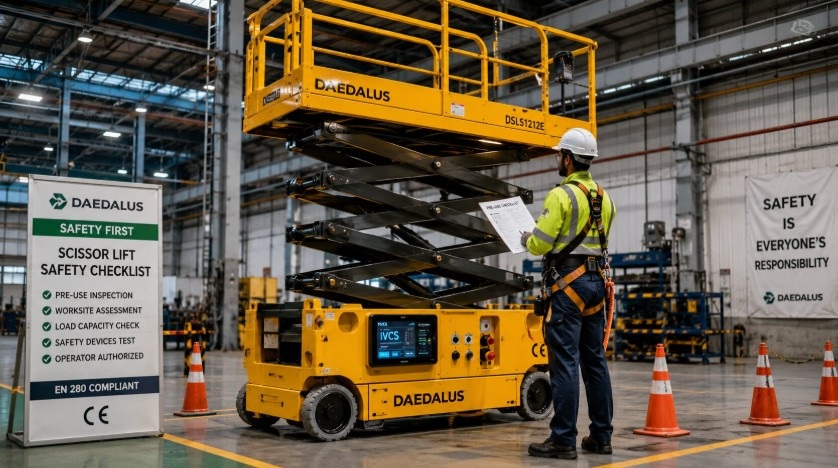
Scissor Lift Safety Checklist: 10 Rules Every Operator Must Follow

Across India's rapidly growing industrial sector — from warehouses in Pune to pharma plants in Hyderabad to aerospace hangars in Bengaluru — scissor lifts are becoming the standard tool for working at height. And with good reason: a scissor lift is safer than a ladder, faster than scaffolding, and more versatile than a fixed platform.
But safe machinery does not automatically mean safe operations. OSHA data shows 300 to 400 workers are injured each year operating aerial or scissor lifts globally, with 20 to 25 fatalities annually. The cause in almost every case is not equipment failure — it is operator error, skipped inspections, and poor worksite assessment.
In India, the Indian Factories Act, 1948 places a direct legal obligation on employers to ensure workers at height are trained, properly equipped, and working on inspected machinery. Working at height is defined as any position where a fall of more than 2 metres is possible. Scissor lifts used anywhere above 2m fall squarely within this definition.
This guide gives you a complete, structured scissor lift safety checklist — plus the 10 non-negotiable rules every operator must internalise before they ever step onto a platform.
Competitor Analysis: What Safety Content Exists for Indian Buyers?
Before writing this guide, we studied what safety information is available from every major MEWP supplier operating in India. The results reveal a clear gap:
| Competitor | Type | Blog Safety Content | India-Specific? | Gap for Daedalus |
|---|---|---|---|---|
| VTech Hydraulics | Indian OEM | Basic checklist only | Partial | No pre/during/post breakdown; no IVCS |
| Dingli India | Global brand | Product-focused, minimal safety | No | No India safety law context |
| JLG / Oshkosh | US brand | Strong safety content (US-centric) | No | All OSHA/ANSI; no Indian Factories Act |
| Genie / Terex | US brand | Good but global, not India | No | Misses Indian regulatory landscape |
| Avcon Systems | Indian OEM | Safety tips; no full checklist | Partial | No structured table, no EN 280 ref |
| DAEDALUS | Indian ODM (CE) | This blog fills the gap | YES | Only CE-certified Indian source |
The gap is clear: no CE-certified Indian manufacturer has published a structured, India-specific scissor lift safety checklist aligned to both EN 280 and the Factories Act. This blog fills that gap — and positions Daedalus as the authority on MEWP safety in the Indian market.
The 3 Most Common Scissor Lift Hazards in India
Understanding what causes accidents is the first step toward preventing them. According to IPAF, three hazards account for the vast majority of MEWP incidents worldwide — and all three are relevant to Indian worksites:

Hazard 1: Tip-overs and Collapses
Tip-overs happen when the machine's centre of gravity shifts too far — caused by overloading, operating on sloped or soft ground, or driving while the platform is elevated. On Indian industrial sites, poorly maintained floors and uneven outdoor surfaces are a common contributing factor.
- Never drive on a slope steeper than the machine's rated gradient
- Never exceed the rated load capacity — include the weight of all workers, tools, and materials
- Never drive the machine while the platform is raised above the drive height limit
Hazard 2: Falls from Height
Falls are the leading cause of scissor lift injuries. OSHA data confirms that most fall incidents happen when operators stand on guardrails, lean over the platform edge, or fail to close the entry gate. In India, inadequate training and a lack of formal pre-use checks amplify this risk.
- Always close and latch the entry gate before raising the platform
- Never stand on guardrails, mid-rails, or any component other than the floor of the platform
- Never lean over the guardrail to reach work areas — reposition the machine instead

Hazard 3: Electrocution
Electrocution incidents have been increasing in MEWP operations since 2015 according to IPAF. OSHA standards mandate that lifts must maintain at least 10 feet from overhead power lines. On Indian factory floors, overhead cables, bus bars, and lighting circuits are common hazards that operators must identify before they begin work.
- Survey the entire travel path for overhead hazards before moving the machine
- Where overhead cables cannot be de-energised, set up physical barriers and warning cones
- De-energise power lines within the work zone wherever possible
10 Non-Negotiable Scissor Lift Safety Rules
These 10 rules are based on EN 280 CE standards, IPAF guidelines, and the Indian Factories Act, 1948. Every operator at any Daedalus-equipped facility must know these by heart.
- Only trained and authorised operators may operate a scissor lift.
The Indian Factories Act requires employers to appoint a competent person to supervise work at height. That means scissor lift operators must receive formal training before their first shift — not on the job. IPAF offers a PAL Card certification that is internationally recognised. All Daedalus machines ship with an operator manual in English and Hindi. - Always conduct a pre-use inspection before every shift.
A 5-minute pre-inspection catches problems before they become emergencies. As per IPAF's MEWP Pre-Use Inspection Checklist, checks must include hydraulic systems, electrical components, guardrails, controls, and the entry gate. Daedalus machines with IVCS provide additional on-screen fault diagnostics to support this inspection. - Inspect and assess the worksite before moving the machine.
Ground conditions are one of the most commonly skipped checks on Indian sites. The surface must be firm, level, and capable of bearing the full weight of the machine plus the maximum rated load. Check for floor drains, cable trenches, or areas of soft ground that may not be visible at a glance. - Never exceed the rated load capacity — not even by a small margin.
Every Daedalus scissor lift has a load rating plate prominently displayed on the platform. This capacity includes the total combined weight of all workers, tools, and materials on the platform. Safety experts recommend keeping the total load below 75% of the rated capacity as a best practice, especially on older machines or rough terrain. - Inspect all safety devices and confirm they are fully operational.
Before every shift, test: the emergency lowering function at ground level, the tilt protection sensor, the electromagnetic brakes, and the entry gate interlock. Daedalus scissor lifts include all of these as standard. Any device that is non-functional must be reported immediately and the machine taken out of service until repaired. - Never drive the machine while the platform is raised above the travel height limit.
This is the single rule most commonly broken on Indian factory floors — usually to save time. Driving a scissor lift with the platform elevated above the manufacturer's permitted drive height dramatically increases the risk of tip-over. The machine's centre of gravity rises with the platform, making any bump, slope, or sharp turn potentially fatal. - Maintain constant awareness of all overhead and lateral hazards.
When the platform rises, the operator's view of overhead hazards becomes limited. Before raising the platform, the operator must physically look upward and identify every overhead hazard: pipes, beams, cables, sprinkler heads, ventilation ducts, or any other obstruction. Lateral hazards — forklifts, other machinery, pedestrians — must also be managed with a designated spotter on the ground. - All occupants must receive a safety briefing before boarding the platform.
Under ANSI A92-2018 standards adopted internationally, not just the operator but every person on the platform must receive a pre-job safety briefing. This includes understanding basic controls, weight limits, guardrail rules, and what to do in an emergency. At minimum, one non-operator occupant must be trained to lower the platform from the ground-level emergency control. - Never modify or override any safety device or warning system.
Scissor lifts are engineered with interlocked safety systems for a reason. Disabling tilt alarms, bypassing load sensors, or removing guardrail sections to make the job faster is a direct violation of EN 280 standards and the Indian Factories Act. Any modification to a MEWP may only be made with written approval from the manufacturer — in Daedalus's case, from our engineering team in Pune. - Conduct a complete post-use inspection and document any issues found.
After the shift ends: lower the platform fully, plug in the charger (for electric models), and complete the post-use inspection log. Any damage, fault codes, or anomalies observed during the shift must be documented and reported to the site supervisor immediately. This ensures the next operator does not unknowingly use a compromised machine.
The Complete 22-Point Pre-Use Safety Checklist
Print this table and keep it at the machine. Every shift, every operator — no exceptions.

| ☐ | Item to Check | Why It Matters |
|---|---|---|
| BEFORE OPERATION | ||
| ☐ | Inspect guardrails and mid-rails for damage or missing pins | First line of fall protection — non-negotiable |
| ☐ | Check hydraulic hoses and fluid levels for leaks | Hydraulic failure mid-lift causes sudden platform drop |
| ☐ | Test all controls: lift, lower, drive, emergency stop | A delayed control response at height can be fatal |
| ☐ | Verify load rating plate is visible and readable | Overloading is the top cause of tip-overs in India |
| ☐ | Inspect wheels and tyres for damage or flat spots | Unstable wheels on factory floors cause drift and tipping |
| ☐ | Confirm battery charge level (for electric models) | Dead battery strands operators at height |
| ☐ | Check entry gate latch and fall protection anchor point | Gate must close securely; harness anchor must hold your weight |
| WORKSITE CHECKS | ||
| ☐ | Survey ground surface for slopes, pits, or soft ground | Ground failure is the #1 cause of tip-overs on Indian sites |
| ☐ | Identify all overhead hazards: pipes, beams, live cables | Electrocution and entrapment — both can be fatal |
| ☐ | Mark out and cordon off the work zone from foot traffic | Moving vehicles and pedestrians cause collision incidents |
| ☐ | Check wind speed (outdoor use only, max 12.5 m/s) | Wind destabilises the platform at height |
| DURING OPERATION | ||
| ☐ | Never exceed the rated load capacity (include tools + people) | Every extra kg shifts the centre of gravity outward |
| ☐ | Never drive the machine while the platform is raised | Lateral movement when elevated dramatically raises tip risk |
| ☐ | Keep all body parts within the guardrails at all times | Reaching over the rail can cause falls even at low heights |
| ☐ | Maintain 10-foot clearance from live electrical lines | Power lines can arc — electricity can jump the gap |
| ☐ | Report any fault or warning indicator to supervisor immediately | Faults worsen under load — never ignore warning lights |
| AFTER USE | ||
| ☐ | Lower the platform fully before leaving the machine | Raised platforms in storage areas are a hazard to others |
| ☐ | Plug in the charger for electric models after every shift | Undischarged batteries degrade faster and fail suddenly |
| ☐ | Document and report any damage or issues observed | Prevents the next shift from using a compromised machine |
Choosing the Safest Daedalus Scissor Lift for Your Application
Not all worksites are the same. Using the wrong machine in the wrong environment is itself a safety risk. Here is how to match the right Daedalus MEWP to your application:
| Daedalus Product | Best For | Working Height | Key Safety Feature |
|---|---|---|---|
| Self Propelled Slab Scissor Lift | Warehouses, factories, airports | 6m – 18m | Proportional drive; EM brakes; tilt sensor |
| Rough Terrain Slab Scissor Lift | Outdoor sites, construction yards | 6m – 18m | 2WD, large battery, terrain stability |
| Manual Pushable Scissor Lift | Tight indoor spaces, retail, events | 4m – 8m | Lightweight; easy lockout; no-slip platform |
| Articulating Boom Lift | ISRO, HAL, tall structures | 12m – 20m | Full harness anchors; IVCS fault detection |
| JIB Master Vertical Mast Lift | Congested indoors, narrow aisles | 6m – 12m | Zero tail swing; 340° rotation; compact safety |
Explore the full Daedalus product range:
- Self Propelled Slab Scissor Lift — Ideal for warehouses, factories, airports, and cleanroom environments
- Manual Pushable Scissor Lift — Best for tight indoor spaces, retail, and light-duty maintenance work
- Rough Terrain Slab Scissor Lift — Built for outdoor construction sites, uneven ground, and heavy-duty applications
- Articulating Boom Lift — For ISRO, HAL, power plants, and complex access tasks above 12m
- JIB Master Vertical Mast Lift — For congested indoor spaces where no other machine fits
Related Reading from the Daedalus Blog
Want to go deeper on access equipment decisions? These articles from the Daedalus blog cover the questions we hear most from Indian buyers and facility managers:
- Scissor Lift vs Boom Lift: Which is Right for Your Industry in India? — Full head-to-head comparison covering height, terrain, cost, and industry fit
- Our Full Product Range — Browse all CE-certified Daedalus MEWPs with specifications and enquiry forms
- About Daedalus: India's Only CE-Certified ODM — Learn how we design, manufacture, and support every machine from our Pune facility
- CE Certification and Safety Standards — Download our EN 280 CE certificates and safety documentation
Frequently Asked Questions
Q1. Is a scissor lift operator required to wear a harness in India?
Under EN 280 standards — which govern all CE-certified MEWPs including all Daedalus machines — guardrails provide primary fall protection on a scissor lift. A full-body harness is not always mandatory on a scissor lift, unlike on a boom lift. However, the Indian Factories Act, 1948 requires employers to provide harnesses whenever a fall of more than 2 metres is possible. Many Indian companies mandate harnesses on all MEWPs as part of their internal EHS policy. Always follow your site's specific safety policy, and when in doubt, wear the harness.
Q2. How often should a scissor lift be formally inspected in India?
Scissor lifts require three levels of inspection: a pre-use inspection by the operator before every shift, a frequent inspection by a qualified person every 3 months (or as per the manufacturer's recommendation), and an annual thorough inspection by a competent engineer. All Daedalus machines include a pre-use checklist in the operator manual and the IVCS system provides real-time diagnostics. Contact the Daedalus service team to schedule a formal inspection.
Q3. Can a scissor lift be used outdoors in India during the monsoon season?
Outdoor use of scissor lifts during monsoon conditions requires specific precautions. Daedalus Rough Terrain Scissor Lifts are rated for outdoor use but must not be operated in wind speeds exceeding 12.5 m/s (the EN 280 outdoor limit). Wet ground, flooding, and reduced visibility all increase risk. During heavy rain, the platform should be lowered and the machine moved to shelter. Indoor Self Propelled Slab Scissor Lifts must never be used outdoors — their tyres and frame are not rated for outdoor conditions.
Q4. What does EN 280 CE certification mean for scissor lift safety?
EN 280 is the European standard that governs the design, manufacture, and testing of Mobile Elevating Work Platforms. CE certification confirms that a machine has been independently tested and verified to meet every structural, mechanical, and safety requirement of EN 280. Daedalus is India's only indigenous MEWP manufacturer to hold CE certification. This means every Daedalus machine meets the same design and safety standard as machines from global brands like JLG and Genie — but is built in India at a fraction of the cost, with local service support.
Q5. What should I do if the scissor lift shows a fault warning while elevated?
Do not panic. Do not attempt to diagnose or repair the machine while elevated. Use the emergency lowering function — located at the ground-level control panel on all Daedalus machines — to lower the platform to ground level. Once safely at ground level, do not restart the machine. Tag it out of service, document the fault code displayed on the IVCS screen, and contact the Daedalus service team at daedalusind.com/contact or call +91 8956261385. Do not operate the machine until the fault has been diagnosed and cleared by a qualified Daedalus service engineer.
Q6. How does the Daedalus IVCS improve scissor lift safety?
The Intelligent Vehicle Control System (IVCS) is a proprietary Daedalus technology that monitors the machine in real time. It displays battery level, fault codes, tilt warnings, and load status on an operator dashboard. If a fault is detected — a hydraulic pressure drop, a tilt sensor alert, or a low battery condition — the IVCS alerts the operator before the issue becomes a safety event. No other Indian MEWP manufacturer offers an equivalent system. Learn more at daedalusind.com.
Get a CE-Certified Scissor Lift for Your Indian Facility
Your team deserves equipment that is designed for safety from the ground up — not safety retrofitted after the fact. Every Daedalus scissor lift is CE-certified to EN 280, built in India with 85% locally sourced components, and backed by a pan-India service network that can reach your site anywhere in the country.
Call us: +91 8956261385 | +91 8956261381
Request a Free Quote at daedalusind.com/contact | Browse All Products
