
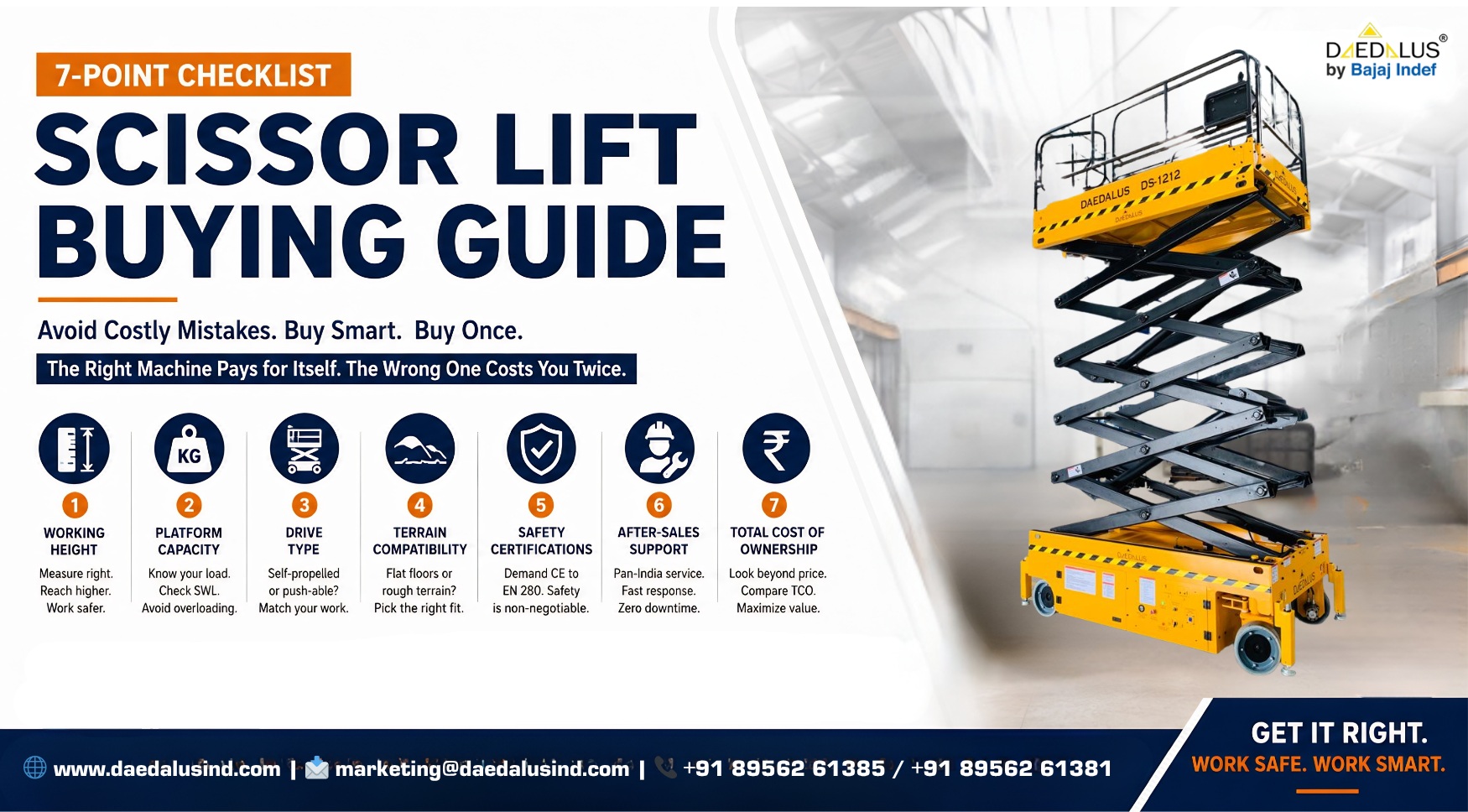
This scissor lift buying guide helps Indian facility managers, procurement teams, and business owners avoid costly mistakes before signing a purchase order. It covers 7 essential checkpoints: working height, platform capacity, drive type, terrain compatibility, safety certifications, after-sales support, and total cost of ownership. Get all 7 right and your machine pays for itself. Miss even one and you'll pay twice.
You've decided your team needs a scissor lift. Good. Now comes the part where most buyers go wrong.
They look at price first. They compare two brochures. They pick the cheaper one. And three months later, the machine either can't reach the required height, has no service engineer within 400 km, or fails an inspection because it lacks a valid safety certification.
In India, this happens more than you'd think.Working at height accounts for a significant share of industrial accidents, and a large number of those incidents involve poorly specified or under-maintained equipment. The right machine, chosen correctly, keeps your team safe and your operations moving.
This scissor lift purchasing guide gives you a clear, practical checklist built for Indian worksites. Whether you're buying your first machine or expanding a fleet, these 7 checkpoints will help you buy smart and buy once.
Let's get into it.
What Working Height Do You Actually Need?
Working height is the total height a person can reach while standing on the platform. It's calculated as platform height plus approximately 2 metres for an operator's reach. This is the number that tells you whether the machine will actually complete the job.
Most buyers focus on platform height. That's a mistake. If your facility has racking or ceilings at 9 metres, you need a machine with at least 9 metres of working height, not platform height. The difference matters.
Here's how to calculate it correctly:
- Measure the highest point your team needs to reach (in metres)
- That number is your minimum working height requirement
- Add a 0.5m buffer for comfortable, safe operation

Daedalus self-propelled scissor lifts cover working heights from 6m (DS-608) to 14m (DS-1412). That range covers most warehousing, manufacturing, and infrastructure applications in India.
Don't buy to your exact minimum. Go one model up. The extra reach costs less than the downtime when your current machine falls short mid-project.
Platform Capacity: How Much Weight Will You Put on It?
Platform capacity, also called Safe Working Load (SWL), is the maximum combined weight the platform can carry. This includes all workers, tools, and materials on the platform at the same time.
Overloading a scissor lift platform is one of the most common and most dangerous worksite mistakes.IPAF (International Powered Access Federation) reports that overloading is a leading cause of MEWP-related incidents globally.
Before you buy, calculate your real-world load:
- Number of operators on the platform x average weight per person
- Weight of tools (drills, grinders, wiring reels, etc.)
- Weight of any materials carried up (conduit, panels, fittings)
All Daedalus scissor lifts are rated for a platform capacity of 350 kg. That supports two workers plus a reasonable tool and materials load for most maintenance, installation, and inspection tasks.
If your job regularly requires carrying heavy materials at height, shortlist machines with higher SWL ratings and check that the rating is certified, not just claimed. A CE-certified SWL is verified. An uncertified one is a number on a brochure.
Self-Propelled vs. Push-able: Which Drive Type Fits Your Site?
Self-propelled scissor lifts move under their own electric power. Push-able (manual) scissor lifts are moved by the operator on the ground. Choosing the wrong type adds hours of unnecessary labour to every working day.
Self-propelled lifts are the right choice when:
- Your facility is large (warehouses, hangars, manufacturing plants)
- Operators need to reposition frequently during a shift
- The floor surface is flat, smooth, and hard
Push-able lifts work well when:
- The job is in a fixed area or small space
- You need a lower-cost option for lighter maintenance tasks
- The machine needs to fit through narrow doorways or aisles
Daedalus offers both. The self-propelled DS-series (DS-608 through DS-1412) features proportional drive control, which lets operators manoeuvre precisely in tight spaces. This is a key advantage in crowded warehouse aisles or production floors.
The push-able DS_M_AC series (DS-608_M_AC through DS-1212_M_AC) covers indoor tasks where self-propulsion isn't necessary.
If you're unsure which type suits your site, map out a typical operator shift. How far does the machine travel in a day? How often is it repositioned? The answers will tell you which category to shortlist.
Does the Machine Match Your Terrain?
A standard scissor lift is built for flat, hard, indoor surfaces. If your worksite has slopes, gravel, uneven ground, or outdoor conditions, a standard machine will struggle and potentially fail.
This is a particularly common issue on Indian construction sites, infrastructure projects, and industrial yards. The floor conditions vary widely, and a machine specified for a factory floor will not perform the same way on an unpaved site.
For those environments, you need a rough terrain scissor lift.Daedalus rough terrain models (DS-1218RT, DS-1418RT, and DS-1618RT) are built with larger, all-terrain tyres and higher ground clearance to handle the unpredictability of outdoor sites.
Before finalising any machine, visit your actual worksite and check:
- Floor material (concrete, tiles, asphalt, gravel, soil)
- Maximum slope or incline percentage
- Any thresholds, ramps, or transitions the machine must cross
- Indoor vs. outdoor use (or both)
Buying a flat-surface machine for an outdoor yard is one of the most expensive specification mistakes you can make. The machine won't be safe, it won't perform, and your team will avoid using it.
What Safety Certifications Should You Demand?
Any scissor lift purchased for commercial or industrial use in India should carry CE certification to EN 280 as a minimum standard. EN 280 is the European standard for the design and safety of Mobile Elevating Work Platforms. It covers structural integrity, stability, controls, and safety systems.
A machine without this certification has not been independently verified to meet global safety requirements. That puts your operators at risk and your organisation at legal risk under Indian factory and workplace safety regulations.
When evaluating any machine, ask the vendor for:
- CE declaration of conformity (a legal document, not a sticker)
- EN 280 test reports
- Details of the onboard safety systems
All Daedalus machines are fully designed and manufactured to EN 280 (CE) standards. Every unit includes tilt protection (which prevents operation on an unsafe incline), electromagnetic brakes (which lock the machine in position during elevated work), and the Daedalus Intelligent Vehicle Control System.
That last point matters more than it sounds. Most manufacturers fit third-party control systems. Daedalus designed its Vehicle Control System in-house. That means the team that built the machine also built the brain that runs it. Fault detection is faster, diagnostics are clearer, and when something needs fixing, Daedalus engineers already know the system inside out.
Don't skip this step. Certifications are the only objective proof that a machine is safe. Vendor assurances are not enough.
Will You Get Service Support Across India?
A scissor lift is a capital asset. It needs to work every time your team needs it. A machine that sits idle waiting for a spare part or a service engineer costs you money every day it's down.
Before you sign any purchase order, ask the manufacturer these questions directly:
- Do you have service engineers stationed in my region?
- What is your guaranteed response time for a breakdown?
- Are spare parts available in India, or do they need to be imported?
- Who do I call at 8 pm if the machine fails during a night shift?
This is where Indian-manufactured machines have a real advantage. Daedalus is an Original Design Manufacturer (ODM) based in Pune. With 85% of components sourced from India, spare parts are available locally and quickly. There's no waiting for imports. There's no intermediary between you and the people who built the machine.
Daedalus has built a pan-India service network precisely because downtime on a worksite is not acceptable. The inbuilt smart battery charger also comes with fault code diagnostics, so minor issues can be identified and resolved without always needing an engineer on site.
If a vendor can't clearly answer your service questions, that's your answer. Walk away.
Total Cost of Ownership, Not Just Purchase Price
The purchase price of a scissor lift is just the beginning. The real cost is what you spend over the machine's lifetime: maintenance, batteries, tyres, consumables, and the cost of downtime when it breaks.
Total Cost of Ownership (TCO) is the framework that helps you compare machines honestly. Here's a simple way to build your TCO comparison:
|
Cost Category |
What to Include |
|
Purchase price |
Invoice value including GST |
|
Annual maintenance |
Service contracts or on-demand charges |
|
Battery replacement |
Typically every 3-5 years |
|
Consumables |
Tyres, hydraulic fluid, filters |
|
Downtime cost |
Lost productivity per day the machine is idle |
|
Resale value |
Estimated value after 5-7 years |
Indian-manufactured machines with locally sourced components consistently score better on TCO than imported machines with overseas supply chains. Spare parts are faster to get and less expensive. Local service engineers cost less per call-out. And resale value holds better when the brand has a strong domestic presence.
Whether you're buying outright or evaluating a rent-to-own arrangement, always build a TCO estimate before comparing price tags. The cheaper machine on day one is often the more expensive machine over five years.
For applications that need greater horizontal reach or multi-level access, also consider looking atDaedalus articulating boom lifts or theJIB Master vertical mast lift range as part of your broader fleet evaluation.
Conclusion
Buying a scissor lift in India doesn't have to be complicated. But it does require discipline. Work through these 7 checkpoints before you commit to any machine:
- Calculate the working height you actually need
- Know your real platform load before you compare SWL ratings
- Match the drive type to how your team works
- Verify the machine handles your actual terrain
- Demand CE certification to EN 280, in writing
- Confirm pan-India service support before signing
- Compare total cost of ownership, not just purchase price
The right machine will pay for itself in productivity, safety, and uptime. The wrong one will cost you far more than the difference in price.
Ready to find the right machine for your worksite?
Browse the full range ofDaedalus Self-Propelled Scissor Lifts, CE-certified and manufactured in Pune, with models covering 6m to 14m working height. Our team will help you match the right model to your exact requirements.
Call us on +91 8956261385 or write to us at sales@daedalusind.com. We're here to help you get it right the first time.
Frequently Asked Questions
What is the difference between working height and platform height on a scissor lift?
Working height is the total height an operator can reach from a scissor lift. It equals the maximum platform height plus approximately 2 metres for the average person's reach. Platform height is just the height of the platform floor itself. Always use working height, not platform height, when specifying a machine for your worksite.
Is CE certification mandatory for scissor lifts in India?
CE certification is not currently mandated by Indian law for all MEWP purchases. However, it is the globally recognised benchmark for MEWP safety under theEN 280 standard. Purchasing a CE-certified machine significantly reduces your liability risk and ensures the machine has been independently verified for structural and operational safety. Many large clients and facility managers now require CE certification as a vendor qualification criterion.
Can a self-propelled scissor lift be used outdoors on uneven ground?
Standard self-propelled scissor lifts are designed for flat, hard indoor surfaces. Using them on uneven, sloped, or unpaved outdoor terrain is unsafe and can void the machine's certification. For outdoor or rough terrain applications, you need a dedicated rough terrain scissor lift with appropriate tyres, ground clearance, and stability ratings. Daedalus offersrough terrain models (DS-1218RT to DS-1618RT) built specifically for those conditions.
How often does an electric scissor lift need servicing?
Most electric scissor lifts require a scheduled service every 250 to 500 operating hours, or at minimum once a year, whichever comes first. Key service items include hydraulic fluid, battery health checks, brake inspection, and structural inspection.IPAF recommends following the manufacturer's maintenance schedule strictly to maintain safety certification validity. Daedalus machines include a smart battery charger with onboard fault code diagnostics, which helps identify issues between scheduled service intervals.
What is the typical price range of a scissor lift in India in 2025?
Scissor lift prices in India typically range from approximately ₹4.5 lakh for a basic push-able model to ₹18-22 lakh or more for a larger self-propelled or rough terrain unit, depending on working height, capacity, and features. Imported machines often carry higher price tags due to customs duties and import costs. Indian-manufactured machines like Daedalus offer competitive pricing with the added advantage of locally available spare parts and service support, which reduces the total cost of ownership over time.
