
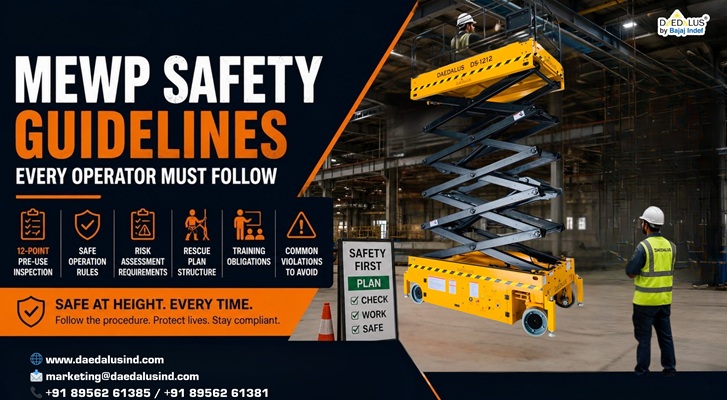
Every MEWP operator in India must follow documented safety procedures before, during, and after platform use. Legal obligations exist under the Factories Act 1948 and BOCW Act 1996. This guide covers the 12-point pre-use inspection checklist, operational safety rules, risk assessment requirements, rescue plan structure, training obligations, and the most common safety violations to avoid. Use it as a reference document on-site.
A MEWP is one of the safest ways to work at height. When it's operated correctly. When it isn't, a fall from a platform, a tipped machine, or a stranded operator can cause a fatality that no amount of paperwork undoes.
The problem is that most MEWP incidents aren't caused by equipment failure. They're caused by operators who skipped the pre-use check, supervisors who assumed someone else had written the rescue plan, or procurement teams that bought uncertified machines because they were cheaper. These are preventable failures, every one of them.
At Daedalus, we've manufactured CE-certified MEWPs in Pune since 2017. We supply machines to warehouses, pharmaceutical plants, construction sites, and aviation facilities across India. What follows is the practical MEWP safety guidance we give our own customers. It covers what Indian law requires, what EN 280 sets as the global design standard, and what actually keeps operators safe at height.
What Are the MEWP Safety Precautions Before You Start the Machine?
|
Pre-use inspection is the single most important safety step in MEWP operation. Before starting the machine, every operator must verify the platform's mechanical condition, the site surface, the overhead environment, and their own authorisation to operate. Skipping any of these checks means the machine has not been verified as safe to use, regardless of how recently it was serviced. |
That pre-use check must happen before every shift, not just the first time the machine is used on a site. If a platform is used for multiple shifts, the inspection and functional test must be completed before each shift begins.
The 12-Point Pre-Use Inspection Checklist:
- Confirm the operator's manual is on board. EN 280 requires it to travel with the machine. If it's missing, don't operate.
- Inspect tyres or castors. Check for damage, correct inflation on pneumatic tyres, and foam-fill integrity on rough terrain models.
- Test the emergency lowering function from ground level. It must be accessible and operational before anyone goes up.
- Inspect platform guardrails and mid-rails. No missing pins, no bent sections. All platform gates must be self-closing.
- Check the battery charge. A fully charged battery protects you if the job runs longer than expected.
- Test all controls at ground level before elevating. Drive, lift, tilt alarm, horn. If anything fails to respond, tag the machine out of service and report it.
- Inspect the work area surface. Look for floor drains, soft ground, slopes, or debris that could affect stability.
- Check the overhead environment. Identify power lines, pipes, sprinkler heads, and structural beams within the working radius.
- Verify the rated load capacity against your actual load. Tools plus materials plus operator weight must not exceed the platform's Safe Working Load (SWL).
- Confirm the tilt indicator is active. On Daedalus machines, the Daedalus Intelligent Vehicle Control System (DIVCS) monitors tilt automatically and prevents operation on unsafe gradients. Verify the system is live before elevating.
- Deploy outriggers if your machine requires them. This applies to boom lifts. Check the outrigger pads are on firm, level ground.
- Confirm the rescue plan is in place and understood. Do not elevate without a trained ground-based rescue person present who knows how to operate the emergency descent controls.
For self-propelled slab scissor lifts used in warehouse and industrial environments, pay particular attention to floor surface condition. A polished concrete floor looks level, but a small gradient near a loading bay can exceed a machine's rated working slope.
Core Operational Safety Rules During MEWP Use
Once the platform is elevated, a different set of rules applies. Most MEWP incidents happen not because something went wrong with the machine, but because the operator made a decision they shouldn't have.
Platform and Load Discipline
- Never exceed the Safe Working Load. This limit includes the operator, every co-worker on the platform, tools, and materials. It's a combined total, not a per-person figure.
- Distribute load evenly. Don't stack materials to one side of the platform.
- Don't use the platform as a hoist. MEWPs are designed to elevate people, not to function as goods lifts.
- Tether tools and equipment at height. An unsecured spanner dropped from 8 metres generates enough force to cause a serious injury at ground level.
Drive and Elevation Rules
- Do not travel at elevated height beyond the machine's permitted travel height. Check your model's specification sheet. For most slab scissor lifts, this is the stowed position.
- Use proportional drive controls. Avoid sudden directional changes at height. Daedalus's proportional drive system is designed for smooth, controlled movement in tight spaces.
- Never drive over unsecured floor covers, drainage gratings, or soft surfaces.
- Sound the horn before moving. Not everyone nearby is paying attention.
- Keep the platform entry gate closed and latched at all times when elevated.
Personal Safety
- Always stand firmly on the floor of the basket. Do not sit or climb on the handrails of the basket at any time.
- For boom lifts: a full-body harness with a restraint lanyard attached to the machine's designated anchor point is required. EN 280-1:2022 requires anchor points to withstand a static load of at least 6 kN. Check your machine has a compliant anchor point before attaching your lanyard.
- For scissor lifts: the need for fall protection should be determined by a site-specific risk assessment. EN 280 guidance notes it is not normally necessary for personnel on vertical lifts to wear fall protection other than in exceptional circumstances, but a risk assessment must confirm this.
- Never lean over the guardrail to extend your reach. If you can't reach the work from inside the platform, lower the machine, reposition, and re-elevate. It takes three minutes. A fall takes a fraction of a second.
Environmental Awareness
- Stop operations if weather conditions deteriorate significantly. Check your machine's specification for its rated maximum operating wind speed and do not exceed it.
- Do not operate near live overhead electrical conductors without calculating the minimum safe approach distance under CEA Regulations 2023.
- Establish pedestrian exclusion zones below the work area. Dropped objects are a serious hazard to anyone below.
What a MEWP Risk Assessment Must Cover
|
A MEWP risk assessment is a documented evaluation of the hazards at a specific worksite before operations begin. Under the Factories Act 1948 and BOCW Act 1996, employers have a legal duty of care for workers performing tasks at height. A generic, undated template does not satisfy this duty. The assessment must be site-specific, task-specific, and reviewed whenever site conditions change. |
Before MEWP operation and during use, the operator must verify a workplace inspection of the work area has been completed. The site must be walked and checked for all possible hazards. The risk assessment must cover all of the following:
- Site surface assessment. Floor load capacity, gradient, surface condition. For older industrial buildings, floor loading calculations may be needed before bringing in a heavier rough terrain machine.
- Overhead hazard identification. Power lines, pipes, structural elements, sprinkler systems, lighting rigs.
- Proximity hazards. Other plant and equipment in the area, vehicle routes, pedestrian paths.
- Weather and environmental conditions. Particularly relevant for outdoor operations and sites with dust, chemicals, or flammable atmospheres.
- Operator competency. Confirm the person operating the machine is authorised and trained for this specific machine type.
- Emergency egress and rescue. The rescue plan must be part of the risk assessment, not a separate afterthought.
- Machine suitability. Confirm the MEWP type, working height, platform capacity, and surface capability match the task. Using the wrong machine creates risk the best-trained operator cannot fully manage.
- Load assessment. Confirm the combined weight of operator, co-workers, tools, and materials does not exceed the platform's SWL.
When Is a Rescue Plan Required for MEWP Use?
|
A rescue plan is required every time a MEWP is used. This is not a high-risk sites only requirement. A rescue plan must be developed, documented, and communicated before anyone operates a MEWP. Scenarios that require it include: battery failure, technical malfunction, a trapped platform, and an incapacitated operator. |
What the rescue plan must include:
- The nominated ground rescue person. This person must be familiarised with the MEWP's ground controls and emergency lowering controls, must be available whenever the MEWP is in operation, and must be able to raise the alarm in an emergency.
- Location of the emergency descent controls. Every EN 280-compliant machine has ground-level emergency lowering. The rescue person must know where it is and how to use it before the operator goes up.
- Communication method. Establish how the operator signals distress: radio, phone, or audible alarm. Test it before elevating.
- Suspension trauma protocol. Research indicates that suspension in a fall arrest device can result in unconsciousness, followed by death, in less than 30 minutes. The rescue plan must specify the response sequence for this scenario.
- Emergency services contact and site address. Pre-posted at the work area, not saved only on someone's phone that may be out of battery.
- Evacuation route. How the rescued operator exits the area once lowered.
The Recommended Sequence to Conduct a Safe MEWP Rescue
- Assess. Confirm whether the operator is incapacitated or communicating difficulty. Do not assume incapacitation before making contact.
- Communicate. Establish contact with the operator if possible. Confirm their condition and whether self-rescue is possible via platform controls.
- Activate ground-level emergency descent. If the operator cannot lower the platform, or if the operator has been incapacitated, a person on the ground who has been familiarised with proper use of the controls may use the primary ground controls to lower the machine.
- If ground controls fail, assess secondary options. This may involve using a second MEWP, positioned adjacent with minimal gap between platforms. Power on both machines should be shut off during any transfer.
- Treat for suspension trauma if harness arrest occurred. An operator in midair should pump the legs frequently to reduce the risk of blood pooling. Once rescued, do not allow the person to stand suddenly. Call emergency medical services regardless of apparent injury.
- Do not move a potentially injured operator until emergency services arrive. Document the incident fully, regardless of outcome.
The rescue plan is only useful if it has been practised. Run a ground-level drill before starting work on any new site.
What Training Is Required to Operate a MEWP in India?
|
India does not yet have a single nationally mandated MEWP operator certification equivalent to IPAF (UK) or ANSI A92.22 (USA). However, employer duty of care under the Factories Act 1948 and BOCW Act 1996 requires that operators are demonstrably competent. Verbal instruction from a colleague does not satisfy this requirement. Training must be documented and competency must be assessed. |
Operator training must cover as a minimum:
- Intended purpose and function of all MEWP controls, including platform, ground, and emergency descent controls
- General knowledge of MEWP types, terminology, and components
- Development of job hazard assessments, work area risk assessments, safe use plans, and rescue plans
- Applicable regulations and safety rules in India
- Personal protective equipment appropriate to the task and environment
Training sources available in India:
- Manufacturer-provided training. Daedalus provides operator familiarisation training with every machine supply. This covers the specific controls, emergency functions, and DIVCS diagnostics of the machine being operated.
- NSDC / Sector Skill Council programmes. These are developing. Check current availability for your industry sector.
- IPAF-accredited training. Available through select providers in India. Internationally recognised, structured, and covers both theory and practical assessment.
- Internal EHS department training. Acceptable if delivered by a competent person and fully documented with a signed competency record.
Training must be machine-type specific. Someone trained on a scissor lift is not automatically competent to operate a boom lift. The machine type, group classification, and site environment all affect what the operator needs to know. Refresher training is recommended every two to three years.
MEWP Safety Regulations and the Code of Practice in India
|
India does not yet have a single dedicated MEWP code of practice, but several statutes create legally enforceable working-at-height obligations. CE certification to EN 280 is the internationally recognised manufacturing and design benchmark. EHS managers should treat EN 280 compliance as the design baseline and apply Indian statutory requirements on top. |
|
Regulation |
What It Requires |
|---|---|
|
Factories Act 1948 |
Safe means of access and egress, employer duty of care, fencing of dangerous areas |
|
BOCW Act 1996 |
Working-at-height safety obligations on all construction sites |
|
IS 3696 |
Scaffolding and access equipment safety standards |
|
IS 3521 |
Industrial safety belts and harnesses specification |
|
EN 280 (CE certification) |
MEWP design, manufacturing, stability, safety systems, and testing standard |
|
CEA Regulations 2023 |
Minimum approach distances to live electrical conductors |
|
IEEE 1584-2018 / NFPA 70E |
Arc flash and electrical hazard assessment near live systems |
EN 280 covers a wide range of MEWPs, from scissor lifts and boom lifts to vehicle-mounted and self-propelled platforms. The standard's scope encompasses design calculations, stability criteria, construction, safety features, examinations, and tests.
When procuring MEWPs for Indian sites, always request the CE Declaration of Conformity and verify it references EN 280. Not all imported machines carry valid certification. Daedalus manufactures to EN 280 as a design standard, and CE marking is verified by third-party testing before any machine leaves the factory.
The Most Common MEWP Safety Violations on Indian Sites
Operating without a rescue plan. The rescue plan is documented, communicated, and practised on almost no sites we visit for the first time. It is the most common gap, and it's also the one that turns a recoverable incident into a fatality.
Exceeding the Safe Working Load. Tools and materials get added to a platform without recalculating the combined weight against the SWL. The SWL is a hard limit. There is no margin.
Operating on a surface the risk assessment didn't cover. A machine is set up in one area and then moved to a surface with a different gradient or load-bearing capacity. The original assessment no longer applies.
Elevated travel beyond the permitted height. Operators move the machine short distances at elevated height to avoid lowering and repositioning. Most machines have physical or electronic travel height limiters. Operators bypass or ignore them.
Bypassing tilt alarms. On machines without smart control systems, operators have been known to override tilt sensors to continue working on a slope the machine's stability calculations don't support. Daedalus DIVCS prevents this at the hardware level.
No harness on boom lifts. MEWPs can make unexpected movements, tip over, or be affected by external factors such as wind or collisions. If a worker is not secured, they can fall from the work basket, resulting in serious or even fatal injuries. On boom lifts, a harness and restraint lanyard are not optional.
No pre-use inspection documented. The inspection happened mentally. Nothing was written down. When an incident occurs and the investigation asks whether the machine was checked before use, there's no record.
Moving push-able machines while elevated. For push-able scissor lifts used in retail or HVAC fit-outs, the most common violation is moving the machine while the platform is raised. These are not designed for elevated travel. Lower, move, re-elevate.
Conclusion
MEWP safety comes down to three things: the right machine for the site, a trained operator who follows the procedure, and a rescue plan that exists before the platform goes up. None of these are complicated. All three require discipline.
The good news is that a CE-certified machine removes a significant portion of risk at the hardware level. Tilt protection, electromagnetic brakes, ground-level emergency descent controls, and proportional drive are built into Daedalus platforms precisely because the machine should make dangerous mistakes harder to make, not easier.
Three things to do after reading this:
- Share this guide with your site supervisor or EHS team.
- Walk your current risk assessment against the checklist in this post. If there's no rescue plan attached, add one before the next shift.
- If your current machine doesn't have tilt protection or a documented CE mark, it's time to reassess what you're operating.
|
Talk to a Daedalus Application Engineer Need help matching the right platform to your site, or want to know how DIVCS works on a Daedalus machine? We'll assess your site requirements and give you a straight answer. No generic sales pitch. Email: marketing@daedalusind.com Phone: +91 8956261385 / 8956261381 |
Frequently Asked Questions
What are the main MEWP safety precautions every operator must follow?
Every operator must complete a pre-use inspection before each shift, verify the site surface and overhead environment, confirm the rescue plan is in place, and operate within the machine's rated load capacity and permitted working gradient. During operation, the platform gate must stay closed, load must be distributed evenly, and elevated travel is only permitted within the machine's specified height. A trained ground-based person must be present and familiar with emergency lowering controls at all times.
What is the recommended sequence to conduct a safe MEWP rescue?
First, assess whether the operator is incapacitated or can communicate. Second, attempt to establish contact. Third, activate the ground-level emergency descent controls to lower the platform. If ground controls fail, assess whether a secondary MEWP can be used for extraction. Once lowered, treat for suspension trauma: keep the operator moving their legs, do not allow them to stand suddenly, and call emergency medical services. Document the incident fully regardless of apparent injury severity.
When is a rescue plan required for MEWP use?
A rescue plan is required before every MEWP operation, not just on high-risk sites. It must be in place before the platform is elevated. Scenarios that require activation include battery failure, technical malfunction, a trapped or snagged platform, and an incapacitated operator. The plan must name the nominated ground rescue person, confirm they are familiarised with emergency descent controls, and establish the communication method between the operator and the ground.
What does a MEWP risk assessment need to include in India?
A MEWP risk assessment must cover site surface condition (floor load capacity and gradient), overhead hazard identification, proximity hazards from other plant and personnel, weather conditions, operator competency verification, machine suitability for the task, load assessment against the platform SWL, and a rescue plan. Under the Factories Act 1948 and BOCW Act 1996, this assessment is a legal obligation. It must be site-specific and updated whenever site conditions or tasks change.
What does MEWP stand for in safety, and how does it differ from AWP?
MEWP stands for Mobile Elevating Work Platform. It is the internationally recognised term used in EN 280 and by bodies like IPAF. AWP (Aerial Work Platform) is the equivalent North American term used under ANSI standards. In India, the terms are used interchangeably. MEWPs include scissor lifts, articulating boom lifts, push-able platforms, and vertical mast lifts. All Daedalus products are classified as MEWPs and manufactured to EN 280 CE certification standards.
