
![How Often Should a Scissor Lift Be Inspected? [2026 Guide]](https://daedalusind.com/uploads/blogs/How_Often_Should_a_Scissor_Lift_Be_Inspected.jpg)
How Often Should a Scissor Lift Be Inspected? A Practical Maintenance Guide
Scissor lifts need a pre-use check before every shift, a monthly service inspection by a trained technician, and a full annual inspection by a certified third party. Under Indian regulations — including the Factories Act 1948, BOCW Act 1996, and IS 7293 — documented inspections are a legal requirement for any powered work platform. This guide covers every inspection interval, what each check includes, and a ready-to-use maintenance schedule your team can start with immediately.
One Missed Inspection. One Serious Consequence.
Here is a situation that is more common than it should be.
A scissor lift at a pharmaceutical plant fails mid-shift. The operator is stranded at 10 metres. The emergency lowering valve has not been tested in months. The response team takes 40 minutes to bring the operator down safely.
When the investigation is completed, the finding is straightforward: the last recorded scissor lift inspection was nine months ago. The company faces a regulatory notice under the Factories Act, a damaged machine, and a workforce that has lost confidence in the equipment they rely on.
The difficult part? None of this was inevitable. A structured inspection routine would have caught the fault before it became a failure.
Most facility managers and EHS officers know they should carry out regular scissor lift inspections. The problem is that very few have a clear, documented system for when to inspect, what to check, and how to keep records that hold up under regulatory scrutiny.
This guide closes that gap. You will find the exact inspection intervals required under Indian law, a section-by-section breakdown of what each check covers, and a maintenance schedule framework you can adapt for your own site — whether you manage one platform or a fleet.
How Often Should a Scissor Lift Be Inspected?
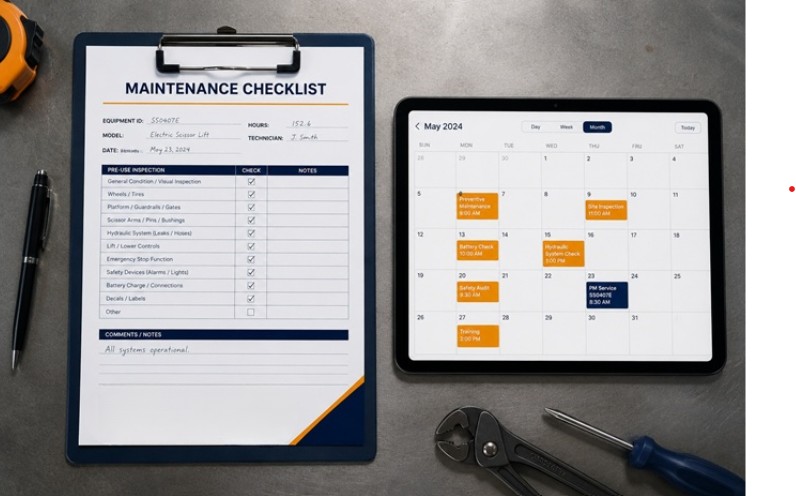
Scissor lifts require three levels of inspection: a pre-use check before every shift, a monthly mechanical inspection by a trained technician, and a full annual inspection by a certified third party. In India, the Factories Act 1948, BOCW Act 1996, and IS 7293 all require documented evidence of periodic inspections for powered work platforms.
Each level of inspection has a different purpose. No single check replaces the others.
The pre-use check is a quick, operator-led walkround before the shift begins. It catches visible damage, low battery, and control faults before anyone goes up. The monthly service goes deeper — hydraulics, scissor arms, battery health, and all onboard diagnostics. The annual third-party inspection provides the formal certification that your regulatory records require.
Remove any one of these levels and you create a blind spot. A daily check will not catch gradual hydraulic seal wear developing over six months. An annual inspection alone will not catch a guardrail damaged by an impact last week.
Here is the full inspection frequency reference:
| Inspection Level | Frequency | Carried Out By | Documentation Required |
| Pre-use check | Before every shift | Operator | Signed daily checklist |
| Monthly service | Every 30 days | Trained technician or OEM service team | Signed service record |
| Six-monthly review | Every 6 months | Senior technician | Structural and electrical log |
| Annual inspection | Every 12 months | Certified third-party inspector | Inspection certificate + load test report |
| Post-incident check | After any impact/tip | Technician + supervisor sign-off | Incident report + clearance certificate |
One additional trigger that is often missed: the post-incident check. Any time a scissor lift is involved in a collision, tip event, or overload situation, it must be fully inspected before it returns to service — regardless of when the last scheduled inspection took place.
Pre-Use Inspection: What to Check Before Every Shift
The pre-use check is the operator's responsibility. It is not the maintenance team's job to complete it on the operator's behalf, and it is not optional on a busy day.
Under IS 7293 — the Bureau of Indian Standards specification for aerial work platforms — operators are required to confirm the equipment is safe before each use. A signed pre-use checklist is the simplest way to meet this obligation and to demonstrate compliance in the event of an audit.
This check takes around 10 minutes. It should happen at the start of every shift, for every platform in use — including push-able scissor lifts, not just self-propelled models.
Pre-use checklist
- Visual walk-around: Inspect the chassis, platform floor, guardrails, gate latch, and all visible structural components for damage, cracks, or anything that looks out of place.
- Tyres and wheels: Check for damage, flat spots, and secure wheel nuts. For pneumatic-tyred rough terrain models, check inflation pressure against the specification.
- Battery charge level: Confirm there is enough charge to complete the planned shift. A battery that runs low mid-job is a real safety risk — the machine may not lower safely at low charge.
- Drive and lift controls: Test all controls at ground level before elevating. Confirm the drive, lift, and lower functions all respond correctly.
- Emergency stop: Test the emergency stop at ground level and, if accessible, on the platform control panel.
- Emergency lowering: Test the manual lowering valve before going up. The operator must know how to operate it from ground level. If it does not work, the machine stays grounded.
- DIVCS fault codes: On Daedalus platforms, check the Daedalus Intelligent Vehicle Control System (DIVCS) display for any active fault codes. A fault code means the machine is not cleared for use until the cause is identified and resolved.
- Tilt sensor: Confirm the tilt alarm activates when tested. Never use a scissor lift on a slope that exceeds the manufacturer's rated limit.
- Platform cleanliness: Remove any tools, materials, or debris left from a previous shift. A cluttered platform is a trip hazard at any height.
If the operator finds any fault, the machine comes out of service. It should be tagged, reported to the maintenance supervisor, and not used again until the fault is repaired and cleared in writing.
A pre-use checklist takes less time than the paperwork that follows an incident. Build it into the start-of-shift routine and it becomes habit within a week.
What Does a Monthly Scissor Lift Service Inspection Include?
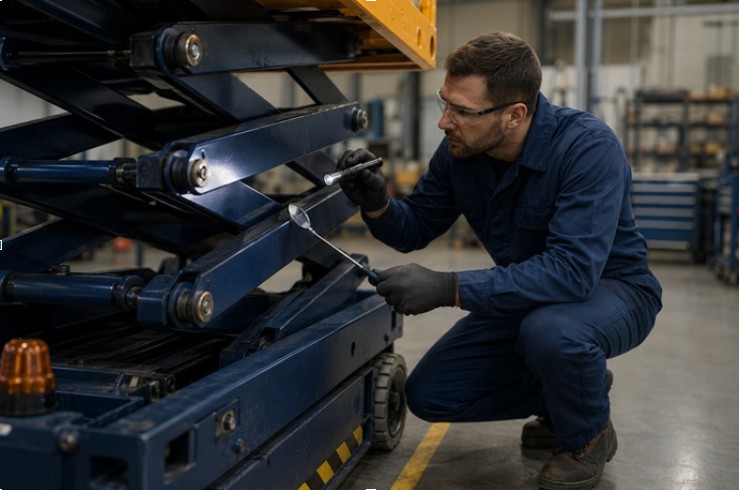
A monthly inspection goes deeper than a pre-use check. A trained technician examines the scissor arms and pivot pins for wear, tests the hydraulic system for leaks and pressure, checks battery health, verifies the emergency descent function, and reviews all onboard diagnostic codes. Every monthly inspection must be documented and signed off by the person who carried it out.
The monthly service inspection should be carried out by someone who understands MEWP hydraulics, electrical systems, and structural components. This means a trained in-house technician, or an OEM service engineer from the Daedalus pan-India service network. It is not a job for the operator unless the operator has received relevant technical training.
Monthly inspection checklist
- Scissor arms and pivot pins: Inspect all scissor arm connections and pivot pins for wear, corrosion, and lateral play. Worn pivot pins are one of the most common causes of platform instability. Early detection costs a fraction of the repair after the problem develops into a structural fault.
- Hydraulic system: Check for leaks at cylinders, hoses, and fittings. Verify hydraulic fluid level and operating pressure. Low or contaminated fluid degrades lift performance and can cause unexpected descent under load.
- Battery health: Test voltage and capacity under load. On flooded lead-acid batteries, check electrolyte levels. If measured capacity has dropped below the manufacturer's recommended threshold, schedule replacement — do not wait for a failure in service.
- Electrical wiring and connectors: Inspect all wiring looms for chafing, damage, or corroded connectors. Pay particular attention to the platform control harness and the charger connection.
- Smart battery charger: Verify the inbuilt charger is functioning and that overcharge protection is active. A charger fault left undetected will damage the battery over successive charge cycles.
- Emergency lowering system: Test the manual descent valve under load. If it does not operate correctly, the machine must not return to service until it is repaired.
- DIVCS diagnostic history: Pull the full fault history from the DIVCS log on Daedalus platforms. Review all active and historic fault codes. Recurring codes that have not generated an obvious symptom yet are early warnings — address them before they develop into failures.
- Guardrails and gate latch: Check all guardrail connections, locking pins, and the entry gate mechanism for structural integrity. A guardrail that feels solid on the ground may behave differently under vibration at height.
- Electromagnetic brakes: Verify that the brakes engage cleanly and hold the machine on the rated slope gradient. A brake that slips under load must be repaired before the platform returns to service.
- Proportional drive system: Check for smooth and predictable response across the full drive speed range. Jerky or unresponsive proportional control in tight spaces is a handling risk.
All findings — including findings of no fault — should be recorded in the machine's service log. The record should include the date, the name and signature of the technician, and the outcome of each check. A blank record is not acceptable for a regulatory audit.
Annual Third-Party Inspection: What It Covers and Why It Is Required
The annual inspection is a formal, documented assessment carried out by a certified third-party inspector who has no connection to your organisation. Your in-house maintenance team cannot sign off the annual inspection, however experienced they are.
Under Sections 28 to 32 of the Factories Act 1948, lifting appliances used in registered factories must be examined by a competent person at intervals not exceeding 12 months. The BOCW Act 1996 carries equivalent requirements for construction sites. The annual third-party inspection is how you meet this legal obligation.
IPAF (International Powered Access Federation) guidance, which is widely referenced by Indian OEMs and safety auditors, also recommends annual third-party inspection as the baseline for compliant MEWP operation.
What a third-party inspector assesses
- Structural integrity: Full examination of the chassis, scissor arm assembly, and platform frame for cracks, weld fatigue, deformation, or corrosion beyond safe limits.
- Load test: The platform is loaded to the rated capacity under controlled conditions to confirm the structure performs safely. Some standards require a test at a defined percentage above the rated capacity.
- Hydraulic certification: Hydraulic pressure is tested and documented against the manufacturer's specification and the requirements of the relevant standard.
- Electrical safety: Insulation resistance is tested and documented in line with CEA Regulations 2023 for battery-powered equipment used in applicable settings.
- EN 280 compliance check: For CE-certified platforms, the inspector confirms the machine continues to conform to EN 280, the international design and safety standard for MEWPs. This is a product-level certification applied to each individual platform by serial number, not a blanket company-level claim.
- Inspection certificate: The inspector issues a signed, dated certificate recording all findings and the machine's clearance status. This document must be kept on-site and made available to factory inspectors, safety auditors, or insurance assessors on request.
If a platform fails its annual inspection, it cannot legally return to service until the identified faults are repaired and a re-inspection confirms it is safe. Using a machine on an expired or failed inspection certificate is a breach of the Factories Act. It also creates direct personal liability for the facility manager or EHS officer who allowed the machine to remain in use.
Daedalus's service network operates across India and can help coordinate annual inspection scheduling and third-party inspector liaison for all Daedalus scissor lift models.
Conclusion
Regular scissor lift inspections are essential for maintaining workplace safety, reducing downtime, and meeting regulatory requirements. A well-structured inspection program should include daily pre-use checks, monthly service inspections, and annual third-party assessments. Each inspection level serves a unique purpose and helps identify issues before they become costly repairs or safety hazards.
For facility managers, EHS professionals, and maintenance teams, the objective is simple: ensure every machine is safe, reliable, and compliant before it is put into operation. By implementing a documented inspection schedule and maintaining accurate records, organisations can improve equipment lifespan, enhance operator confidence, and minimise operational disruptions.
Need a Service Inspection for Your Scissor Lift?
Our pan-India service team supports scheduled maintenance, monthly inspections, and annual certification for all Daedalus scissor lift models. All platforms are CE-certified to EN 280.
Call / WhatsApp: +91 8956261385
Email: sales@daedalusind.com
Explore our scissor lift range at daedalusind.com
Frequently Asked Questions
How often should a scissor lift be inspected?
A scissor lift should undergo a pre-use inspection before every shift, a detailed service inspection every month, and a comprehensive third-party inspection at least once every year. Additional inspections should be conducted after any accident, collision, overload event, or major repair.
Who is responsible for conducting scissor lift inspections?
Daily pre-use inspections are typically carried out by the operator. Monthly inspections should be performed by a trained technician or authorised service provider, while annual inspections should be conducted by a competent third-party inspector.
What should be included in a daily scissor lift inspection?
A daily inspection should include checks of the platform, guardrails, tyres, controls, battery charge level, emergency stop functions, emergency lowering system, hydraulic leaks, and overall machine condition.
Are annual scissor lift inspections mandatory?
Yes. Annual inspections are generally required to verify the structural, hydraulic, and electrical integrity of the equipment and to maintain compliance with applicable workplace safety regulations and industry standards.
What happens if a scissor lift fails an inspection?
If a scissor lift fails an inspection, it should be removed from service immediately. The identified issues must be repaired, and the equipment should be re-inspected before it is returned to operation.
How long should inspection records be kept?
Inspection and maintenance records should be retained for at least five years or for the operational life of the equipment, depending on company policy and regulatory requirements.
