
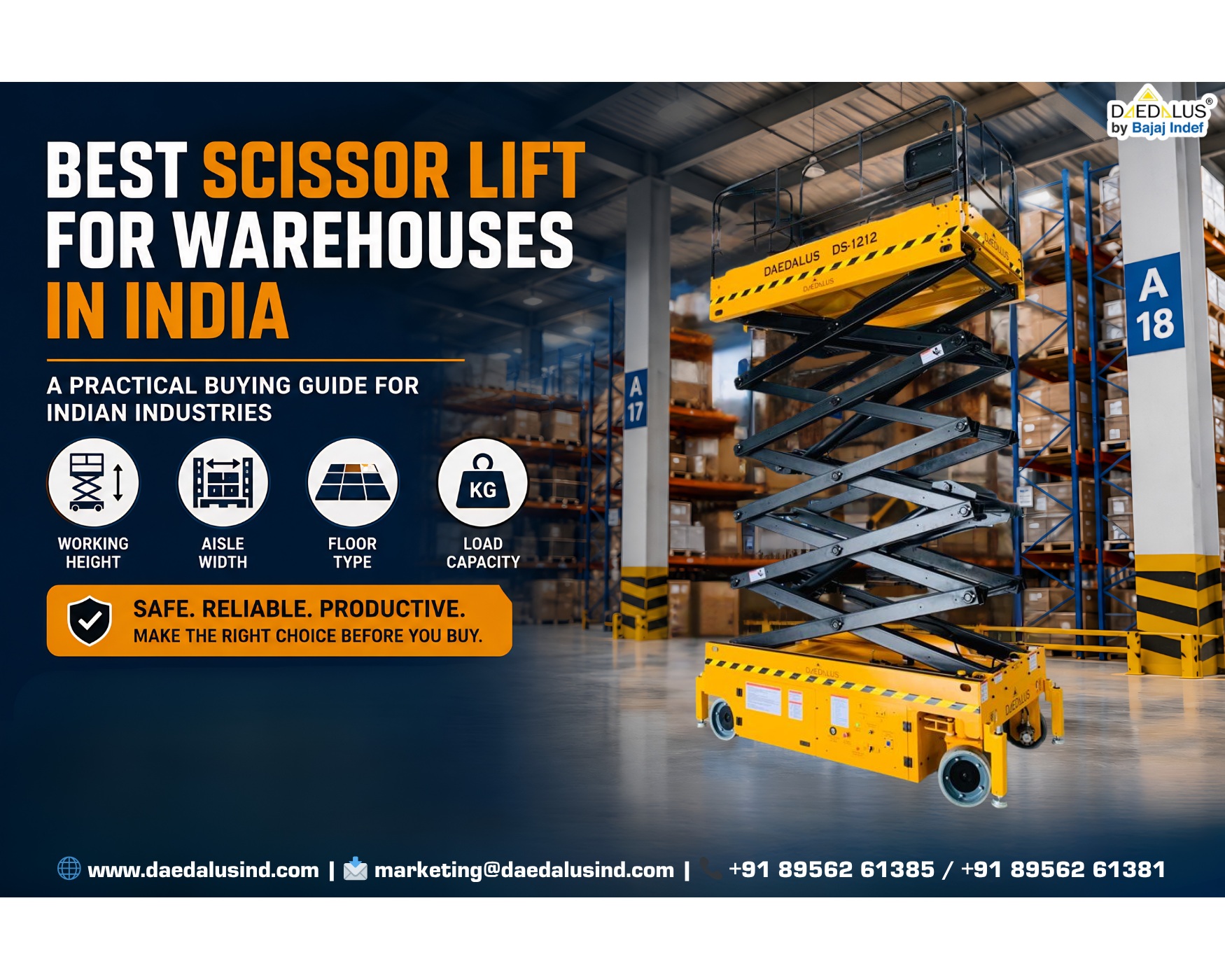
For most Indian warehouses with flat slab floors, an electric self-propelled scissor lift is the right choice. It produces zero emissions, moves quietly through tight aisles, and reaches working heights from 6m to 14m. If your team needs occasional access without a full-time machine, a pushable scissor lift is a cost-effective alternative. The right model depends on your floor type, aisle width, required height, and load. This guide helps you match all four.
Picture this: a maintenance worker climbs an aluminium ladder to fix a light fitting 10 metres above a warehouse floor. Tools in one hand, no guardrails, no second person spotting below. It takes 20 minutes. It happens three times a week.
This is how most Indian warehouses still handle height access. And it is one of the most preventable safety risks in any industrial facility.
A warehouse scissor lift changes everything. It gives your team a stable, enclosed working platform, keeps both hands free for the job, and moves quietly across a flat slab floor without damaging the surface. The question is not whether you need one. The question is which one is right for your warehouse.
According to industry data, the indoor scissor lift segment accounts for over half of the global scissor lift market, and the warehousing and storage sector is growing faster than any other end-use category. Indian warehouses are no exception.
This guide cuts through the confusion. By the end, you will know exactly which type of scissor lift fits your warehouse, what specs to check before you buy, and which mistakes to avoid.
What Makes a Scissor Lift the Right Fit for Warehouse Work?
A scissor lift is the ideal indoor aerial work platform for warehouses because it provides a flat, stable working deck, rises vertically on a small footprint, and produces zero emissions indoors. Unlike ladders or scaffolding, it allows one or two operators to work safely at height while keeping both hands free. It also moves precisely through tight aisles using proportional drive control.
Warehouses have a specific set of challenges. Ceilings are high. Aisles are narrow. Floors are finished. Forklifts and workers share the same space. You cannot afford equipment that slows things down, damages flooring, or puts operators at risk.
A scissor lift solves all of this at once. It lifts vertically, parks compactly, and operates silently. There are no fumes, no noise, no ladder risk. Your team can reach lighting, HVAC ducts, sprinkler systems, structural fittings, and high racking without stopping warehouse operations around them.
There is one important thing to understand before you buy. The "working height" a manufacturer quotes is not the same as the height your operator can actually reach from a standing position.Working height is calculated as platform height plus 1.8 metres to account for the operator's reach. So a "10m working height" lift may only raise its platform to around 8.2m. If your racking tops out at 10m, you need a machine whose platform height reaches 10m.
At Daedalus, our self-propelled scissor lifts cover platform working heights from 6m to 14m, designed specifically for Indian warehouse and industrial worksite conditions.
The Four Types of Scissor Lifts Used in Warehouses
Not all scissor lifts are built for the same job. Here is what each type does best.
Self-Propelled Electric Scissor Lifts

These are the most widely used machines for warehouse work. They run on a battery, drive themselves across the floor, and lift operators to height with the push of a button.Electric-powered scissor lifts held 68.7% of global market revenue in 2024, driven almost entirely by indoor use requirements: zero emissions, low noise, non-marking tyres, and lower total cost of ownership compared to engine-powered alternatives.
Daedalus self-propelled models (DS-608 through DS-1412) carry a platform capacity of 350 kg, include an electric line to the platform, and feature the Daedalus Intelligent Vehicle Control System for easy fault detection and diagnostics. They are CE certified to EN 280 standards. These are the right choice for logistics hubs, manufacturing plants, pharmaceutical facilities, and any warehouse used frequently by maintenance teams.
Pushable (Manual) Scissor Lifts

A pushable scissor lift has no drive motor. The operator positions it manually, then uses a simple AC power source or hand pump to raise the platform. It costs less, weighs less, and needs less maintenance.
Our pushable scissor lift range includes models from DS-608_M_AC through DS-1212_M_AC and the DS-706AC. These are ideal for smaller warehouses, showrooms, retail facilities, and teams that need occasional height access without full-time equipment. If your maintenance team uses the lift twice a week, a pushable model is a smart, cost-effective investment.
Rough Terrain Scissor Lifts
These machines are built for uneven surfaces. They have larger tyres, four-wheel drive, and a sturdier frame. They are the right choice for warehouses under construction, outdoor yard areas, and loading docks with unfinished ground.
Daedalus rough terrain scissor lifts include the DS-1218RT, DS-1418RT, and DS-1618RT. If your warehouse floor is a clean, finished slab, you do not need a rough terrain model. Buying one for indoor slab use means paying more for a heavier machine that is harder to maneuver in narrow aisles.
When a JIB Master or Boom Lift Makes More Sense
Some warehouse tasks require more than straight vertical access. If operators need to reach over racking, around a column, or into a confined overhead space, a compact vertical mast lift or articulating boom lift may serve better.
The DaedalusJIB Master (available in 8m and 10m) is a compact articulating boom lift designed for tight warehouse spaces where a full-sized scissor lift cannot reach. For higher-ceiling facilities or irregular overhead access, ourDBA articulating boom lifts (DBA-12-6 through DBA-20-11) cover working heights up to 20m.
What Should You Check Before Buying a Warehouse Scissor Lift?
Before you buy, check three things: the platform height you actually need (not the marketed working height figure), the width of your narrowest aisle versus the machine's footprint, and the condition of your floor. Get these three wrong and no amount of spec comparison will fix the purchase.
Here is a straightforward checklist to run through before you contact any supplier.
Platform height vs racking height. Measure your top racking level. The scissor lift's platform height must reach that level. A machine whose working height just touches your racking height is not suitable because your operator needs to stand on the platform and work, not stretch from the top of a ladder.
Aisle width. Measure your narrowest operating aisle. Compact electric models in the Daedalus range are designed to maneuver in tight spaces. The machine's width spec must leave room for safe travel and emergency exit.
Floor type. Flat finished slab? A standard electric scissor lift is the right match. Unfinished, outdoor, or rough ground? You need a rough terrain model.
Load capacity. How many operators will use the platform at once? What tools and materials will they carry? Total platform weight must stay within the rated capacity. Daedalus scissor lifts carry up to 350 kg on the platform.
CE certification. This matters more than most buyers realise.CE certification to EN 280 standards means the machine has been designed and tested to verified structural, load, and safety requirements. It reduces your site liability and protects your workers. All Daedalus MEWPs are fully CE certified.
After-sales support. A machine that breaks down with no service team nearby is expensive downtime. Ask your supplier about their pan-India service network before you sign anything. Daedalus operates a widespread service network across India to keep your equipment running and your productivity protected.
Self-Propelled vs Pushable: Which One Does Your Warehouse Actually Need?
A self-propelled electric scissor lift is worth the investment if your team uses it multiple times a week or needs to cover a large floor area. A pushable model is the smarter choice for smaller warehouses or infrequent tasks where motorised travel is not needed. Both types can be CE certified and carry the same platform capacity.
Here is a simple way to decide. Ask yourself two questions.
First: how often will the lift be used? If the answer is every day or multiple times a week, the time savings and operator convenience of a self-propelled model will pay back the price difference quickly. If the answer is once or twice a week for light tasks, a pushable model is more practical.
Second: how large is your warehouse floor? A self-propelled lift drives itself to where it is needed. In a large distribution centre or manufacturing plant, that mobility directly reduces the time your team spends moving equipment around. In a smaller facility, the operator can push a platform into position just as quickly.
Many of our customers start with pushable models when their operations are smaller, then upgrade to self-propelled machines as their throughput and team size grow. Both ranges are designed to work on flat slab floors with the same safety features, so the transition is straightforward.
Electric vs Diesel: Why Electric Always Wins Indoors
For warehouse use, there is no real debate. Electric scissor lifts are the correct choice for any enclosed or semi-enclosed indoor environment.Electric models are smaller than diesel alternatives, nearly silent in operation, and do not produce emissions that would be dangerous or uncomfortable in a closed building.
Diesel or engine-powered lifts produce exhaust fumes. In an enclosed warehouse, that creates a health and safety problem immediately. They are also louder, heavier, and cause more floor damage. The only appropriate use case for a diesel or rough terrain engine-powered lift is outdoors or on unfinished ground.
Electric models cost less to run over time. There is no fuel to buy. Battery charging is simple. The inbuilt smart battery charger on Daedalus machines includes overcharge protection and fault code diagnostics, so your team knows exactly when a charge issue needs attention before it causes downtime.
The Daedalus Intelligent Vehicle Control System takes this further. Designed in-house by our engineering team, it allows easy fault detection and on-machine solutions. This means less time waiting for a technician and more time getting work done.
5 Mistakes Warehouse Buyers Make When Choosing a Scissor Lift
Even experienced buyers make avoidable errors. Here are the five most common ones.
Buying based on working height instead of platform height. As covered earlier, these are not the same figure. Always ask for platform height and compare it against your racking level. This single mistake causes more mismatched purchases than any other.
Choosing the cheapest option without checking certification. A lift without CE certification has not been independently tested to verified safety and structural standards. The short-term saving often leads to higher long-term costs through repairs, liability exposure, and equipment that does not perform under real working conditions.
Ignoring aisle width. A machine that cannot fit in your narrowest operating aisle is useless regardless of how good its other specs are. Always measure first.
Buying a rough terrain model for a finished slab floor. Rough terrain lifts are heavier and wider. They are harder to maneuver indoors and cost significantly more. If your floor is a clean warehouse slab, a standard electric scissor lift is the right machine.
Choosing a supplier with no service network.Equipment that breaks down with no local support means extended downtime. Always ask about spare parts availability, service coverage in your region, and response times before you commit.
Safety and Maintenance: What Every Warehouse Manager Must Know
A scissor lift is only as safe as the pre-use inspection behind it. Before every shift, complete a visual and functional check. Confirm guardrails are locked in place, the battery is adequately charged, hydraulic hoses show no signs of leaks, tyres are in good condition, and the emergency stop button functions correctly.
MEWP inspection regulations in India align with international standards, requiring documented inspections and maintenance records for compliance. A qualified person must verify the equipment's condition before it goes into operation. This is not optional. It is a compliance requirement that protects both your workers and your organisation.
The most serious scissor lift accident is a tip-over. Keep the machine on a flat, level surface. Never exceed the platform's rated load capacity. Mark off the working zone with cones or barriers so other workers and vehicles do not pass underneath the elevated platform.
Daedalus machines include built-in tilt protection that prevents operation on an unsafe incline. Electromagnetic brakes keep the machine stable during work at height. Proportional drive control lets operators maneuver precisely in confined spaces. These are not optional extras. They are standard features that protect your team every time they use the lift.
For ongoing maintenance: conduct a monthly check of hydraulic fluid levels, battery health, and structural welds. Schedule an annual inspection by a qualified technician. Document everything. A well-maintained scissor lift from a quality manufacturer will give you years of reliable, productive operation.
Real Warehouse Applications Where a Scissor Lift Makes the Biggest Difference
Daedalus scissor lifts are used across a wide range of Indian industrial and commercial sectors. Here is how they perform in the environments our customers operate in every day.
E-commerce and logistics distribution centres. Fast-moving, high-rack environments need a lift that can reach the top bay quickly, position precisely, and drive to the next location without delay. Self-propelled electric models handle this with ease.
Pharmaceutical warehouses. Clean floor operation, no emissions, and quiet performance are non-negotiable in pharmaceutical storage. Our electric scissor lifts meet all three requirements. Clients in this sector use them for inventory management, overhead pipework access, and HVAC maintenance.
Automobile and manufacturing plants. Overhead line maintenance, equipment installation at height, and fixture work all require a stable platform with good load capacity. The 350 kg platform capacity on Daedalus machines supports two operators with tools and materials.
Aviation maintenance facilities. High-ceiling hangars and tight bay layouts need compact machines with good reach. The Daedalus JIB Master series and self-propelled scissor lifts are used by aviation sector clients for precisely this reason.
Cold storage and food processing. Narrow aisles, sensitive flooring, and constant through-traffic demand a compact, quiet, non-marking machine. Our electric slab scissor lifts are well-suited to these conditions.
As Vinayak Gore, one of our customers, puts it: "Daedalus Lift and Access Equipments has been a game-changer for our maintenance operations. The equipment is incredibly reliable and easy to use, allowing our team to perform tasks at heights with utmost confidence."
The Right Warehouse Scissor Lift Is a Long-Term Decision
Three things determine the right warehouse scissor lift: the working height matched to your racking, the floor type, and how often your team will use the machine. Get these right and you will have a piece of equipment that pays for itself quickly in saved time, reduced risk, and fewer maintenance complications.
Electric self-propelled scissor lifts are the right choice for most Indian warehouse operations. Pushable models fill the gap for smaller or less frequent applications. CE certification, an intelligent control system, and a reliable pan-India service network are not optional. They are the factors that separate a short-term equipment cost from a long-term operational asset.
At Daedalus, we manufacture all our MEWPs in Pune to EN 280 CE standards, with 85% of components sourced in India. Our Intelligent Vehicle Control System is designed in-house. Our service network is pan-India. And our team is available to help you find the right model for your specific warehouse before you commit to a purchase.
Ready to find the right scissor lift for your warehouse? Contact the Daedalus team today.
Email: marketing@daedalusind.com Phone:+91 8956261385
Frequently Asked Questions
What is the right working height for a warehouse scissor lift in India?
The right working height depends on your top racking level. The key figure to ask for is platform height, not working height. Platform height is the actual elevation of the platform floor at maximum extension. For most Indian warehouses with racking up to 8m, models in the Daedalus DS-808 to DS-1010 range are a good fit. For taller facilities, the DS-1212 and DS-1412 cover up to 12m and 14m respectively.
Can I use an electric scissor lift on a rough or uneven warehouse floor?
No. Electric slab scissor lifts are designed for flat, level, finished surfaces. Using one on uneven ground risks instability and tip-over. If your warehouse floor is unfinished, outdoor, or has grade changes at loading docks, you need a rough terrain scissor lift. Daedalus offers the DS-1218RT, DS-1418RT, and DS-1618RT for exactly these conditions.
What is the difference between a self-propelled and a pushable scissor lift?
A self-propelled scissor lift drives itself under battery power, allowing the operator to travel across the warehouse floor and position the machine without physical effort. A pushable scissor lift is moved manually into position before being raised. Self-propelled models cost more but save significant time in large warehouses or for frequent use. Pushable models are the better choice for smaller facilities or teams with occasional height access needs.
What does CE certification mean for a scissor lift, and why does it matter for my site?
CE certification to EN 280 means the scissor lift has been designed and manufactured to verified European structural, safety, and load standards. For your site, it means the equipment has been independently assessed and meets defined safety requirements. It reduces your liability as the equipment owner, protects your workers, and demonstrates compliance with professional worksite standards. All Daedalus MEWPs are fully CE certified.
How often does a warehouse scissor lift need servicing?
A scissor lift needs a pre-use inspection before every single shift, covering guardrails, battery charge, hydraulic hoses, tyres, and emergency stop function. Monthly checks should include hydraulic fluid levels, battery health, and structural components. An annual inspection by a qualified technician is required for full compliance.MEWP inspection requirements in India align with international standards and require documented maintenance records. Daedalus operates a pan-India service network to support all scheduled and emergency maintenance needs.
