
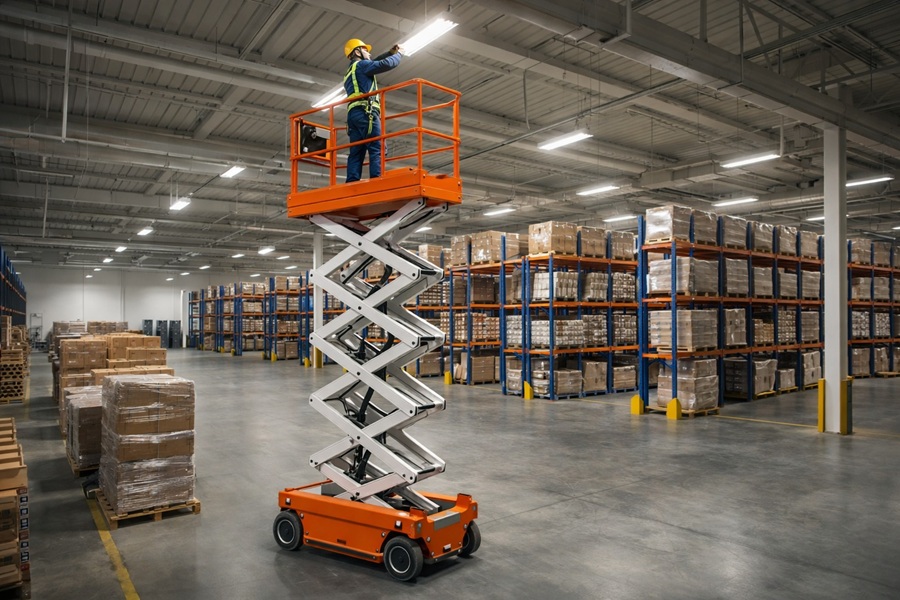
Warehouse maintenance at height is one of the most common — and most risky — challenges facing facility managers across India. Whether it's replacing ceiling lights, servicing HVAC ducts, inspecting storage racks, or checking fire sprinkler systems, any task above ground carries real safety risk.
Most warehouses still rely on ladders or temporary scaffolding. That's a problem. These methods are unstable, slow, and completely unsuitable for regular maintenance at height. Falls from height remain one of the leading causes of workplace injuries in India's industrial sector.
If you manage warehouse operations, choosing the right equipment for warehouse maintenance at height
is not a preference — it's a responsibility. The right machine improves safety, cuts downtime, and gives your team the confidence to work at height without risk.
This guide covers every major equipment option designed for warehouse maintenance, including which Daedalus product fits each scenario.
What Is Warehouse Maintenance at Height?
Warehouse maintenance at height refers to any maintenance activity performed above floor level where workers need elevated access. These tasks are routine but critical for smooth warehouse operations.
Common warehouse maintenance tasks at height include:
-
Replacing or repairing overhead lighting
-
Inspecting and fixing storage racks
-
HVAC and duct maintenance
-
Fire sprinkler and safety system checks
Traditionally, ladders and scaffolding were used for such work. However, these methods are unstable, slow, and unsafe for repeated use. Modern access equipment provides a safer, faster, and more controlled way to work at height inside warehouses.
Why Choosing the Right Equipment Matters
Selecting the wrong equipment for warehouse maintenance can create serious problems.
Safety risks
increase when workers use unstable platforms or equipment not designed for indoor use. Falls from height remain one of the leading causes of workplace injuries.
Productivity suffers
when access is slow or repositioning takes too much time. Maintenance tasks take longer, causing downtime in daily operations.
Compliance issues
arise if safety standards are not met. Warehouses must follow workplace safety regulations to protect employees.
Costs rise
due to accidents, repairs, and operational delays. Preventive investment in the right equipment reduces long-term expenses.
Choosing the right access solution improves safety, efficiency, and overall warehouse performance.
Key Factors to Consider Before Selecting Equipment
Before deciding on equipment, evaluate your warehouse requirements carefully.
-
Working height required:
Measure the maximum height workers need to reach.
-
Indoor vs outdoor usage:
Most warehouse tasks are indoor and need compact, emission-free machines.
-
Floor condition and space constraints:
Narrow aisles and smooth floors require specific equipment designs.
-
Load capacity:
Consider the combined weight of workers and tools.
-
Frequency of maintenance work:
Regular tasks justify dedicated access equipment.
-
Power source preference:
Battery-powered equipment is quieter and ideal for indoor environments.
These factors help narrow down the most suitable equipment for your facility.
Best Equipment for Warehouse Maintenance at Height
Choosing the right access equipment depends on your warehouse layout, the height of work, and how frequently maintenance tasks are performed. Below are the three most effective equipment options used in modern warehouses, explained in simple terms.
Self Propelled Scissor Lifts

Self propelled scissor lifts are the most widely used machines for warehouse maintenance at height. They're best suited for warehouses with open floor areas where a stable, spacious working platform is needed.
Daedalus offers a full range of self propelled slab scissor lifts — from the DS-608
(6m working height) through to the DS-1412
(14m working height) — covering most indoor warehouse ceiling heights across India.
These lifts feature proportional drive control
, making them easy to manoeuvre in compact spaces without jerky movements. The electromagnetic brakes
lock the machine in position once stationary, giving workers a stable platform while performing overhead tasks. The inbuilt smart battery charger with overcharge protection keeps the machines ready for the next shift.
Self propelled scissor lifts are the first choice for ceiling light replacement, fire sprinkler inspection, cable tray work, and any task requiring a large, stable platform at moderate to high indoor heights.
Daedalus Models: DS-608, DS-808, DS-810, DS-1010, DS-1212, DS-1412, DS-1212_1.9v
Daedalus Models: DS-608, DS-808, DS-810, DS-1010, DS-1212, DS-1412, DS-1212_1.9v
<st
Daedalus Models: DS-608, DS-808, DS-810, DS-1010, DS-1212, DS-1412, DS-1212_1.9v
Vertical Mast Lifts – JIB Master
The JIB Master is Daedalus's purpose-built vertical mast lift for compact indoor environments. It is designed specifically for warehouses with narrow aisles, congested storage areas, or tight access points where larger machines simply won't fit.
The JIB Master's compact footprint and zero tail swing allow it to move between storage racks, around machinery, and into confined spaces without disrupting daily warehouse operations. Its precise vertical positioning makes it ideal when maintenance work needs to happen close to shelves, walls, or overhead structures.
Available in 8m and 10m working height variants, the JIB Master covers the most common indoor warehouse ceiling heights while occupying minimal floor space.
For warehouses where aisle width is a constant constraint, the JIB Master solves the access problem that other lifts cannot.
Daedalus Models: JIB_MASTER_8M, JIB_MASTER_10M
Rough Terrain Scissor Lifts
Warehouse facilities aren't always limited to smooth indoor floors. Loading docks, outdoor yards, construction-phase warehouse fit-outs, and facilities with uneven or gravel surfaces demand equipment built for tougher ground conditions.
Daedalus Rough Terrain Slab Scissor Lifts are designed for exactly these environments. The DS-1218RT, DS-1418RT, and DS-1618RT deliver stable, elevated access on uneven surfaces — with working heights from 12m to 16m.
If your warehouse maintenance extends beyond the internal floor area, or if you're operating in a facility that hasn't yet been fully finished, rough terrain scissor lifts are the right choice.
Daedalus Models: DS-1218RT, DS-1418RT, DS-1618RT
Articulating Boom Lifts
Articulating boom lifts are used when warehouse maintenance requires reaching over obstacles or into areas that straight vertical access cannot handle. They move both vertically and horizontally, letting workers position themselves precisely without constantly relocating the machine.
Daedalus's DBA series articulating boom lifts cover working heights from 12m (DBA-12-6) to 20m (DBA-20-11) — the largest working envelope in the Daedalus range. This makes them suitable for high-bay warehouses, complex overhead structures, and maintenance scenarios involving ducts, conveyors, or structural elements that block direct access.
When maintenance tasks require reaching over racking systems, navigating around overhead pipework, or accessing points blocked by warehouse infrastructure, articulating boom lifts are the right tool.
Daedalus Models: DBA-12-6, DBA-14-7, DBA-16-8, DBA-20-11
Scissor Lift vs Mast Lift vs Boom Lift – Which One Should You Choose?
Choosing the right equipment depends on your warehouse layout and maintenance needs.
Scissor Lifts
- Reach type: Vertical Space requirement: Medium to large Best for: Open areas and repetitive overhead tasks
Vertical Mast Lifts
- Reach type: Vertical with limited outreach Space requirement: Very compact Best for: Narrow aisles and indoor maintenance
Articulating Boom Lifts
- Reach type: Vertical + horizontal Space requirement: Medium Best for: Obstructed or hard-to-access areas
Quick guide:
- If your warehouse has wide open floors, choose a
scissor lift
- . If space is tight, choose a
vertical mast lift
- . If obstacles block direct access, choose a
boom lift
- .
Safety Features to Look for in Warehouse Maintenance Equipment
Safety should never be compromised when working at height. Every Daedalus machine includes safety engineering built in from the ground up:
Tilt protection
- to prevent operation on unsafe inclines
Proportional drive control
- for precise, safe manoeuvring in tight spaces
Electromagnetic brakes
- for stable positioning during work
Inbuilt smart battery charger
- with overcharge protection and fault code diagnostics
Daedalus Intelligent Vehicle Control System
- — designed in-house for easy fault detection and diagnostics, giving operators and maintenance teams quick visibility into machine status
CE certification to EN 280 standards
- — the same global safety benchmark used across Europe and recognised internationally
These features are standard across the Daedalus range, not optional extras.
Common Mistakes to Avoid During Warehouse Maintenance at Height
Many accidents happen due to avoidable mistakes.
- Using ladders for frequent maintenance tasks Ignoring floor conditions and space limitations Overloading platforms with tools or materials Choosing equipment based only on cost, not safety
Avoiding these mistakes improves safety and extends equipment life.
Why Daedalus Equipment Is Suitable for Warehouse Maintenance
Daedalus access equipment is designed with real warehouse challenges in mind.
- Built for Indian warehouse conditions Battery-powered, low-noise operation Compact designs for indoor use Safety-focused engineering Strong service and support network across India
Daedalus solutions help warehouses maintain productivity without compromising safety.
Conclusion
Warehouse maintenance at height is unavoidable, but accidents are not. The right equipment—whether a scissor lift, vertical mast lift, or articulating boom lift—makes all the difference in safety, efficiency, and cost control.
Assess your warehouse layout, maintenance tasks, and safety needs carefully. Choosing the right access equipment today prevents risks tomorrow.
Consult experts to choose the right access equipment and ensure safer, smoother warehouse operations.
FAQs
1. What is the safest equipment for warehouse maintenance at height?
The safest equipment for warehouse maintenance at height includes self propelled scissor lifts, vertical mast lifts, and articulating boom lifts. These machines provide stable platforms, built-in safety systems, and controlled access compared to ladders or scaffolding.
- Can scissor lifts be used inside warehouses?
Yes, battery-powered self propelled scissor lifts are widely used inside warehouses. They are emission-free, low-noise, and designed for smooth indoor floors, making them ideal for lighting, sprinkler, and ceiling maintenance tasks.
- Which lift is best for narrow warehouse aisles?
Vertical mast lifts are best for narrow warehouse aisles. Their compact design, small turning radius, and precise positioning allow safe access in tight and congested spaces without disrupting warehouse operations.
- When should an articulating boom lift be used in a warehouse?
An articulating boom lift should be used when maintenance work requires reaching over obstacles such as racks, conveyors, or machinery. Its up-and-over and horizontal reach capabilities make it suitable for complex access situations.
- Why are ladders unsafe for regular warehouse maintenance at height?
Ladders are unsafe for regular warehouse maintenance because they offer limited stability, no fall protection, and minimal working space. Frequent ladder use increases the risk of falls, injuries, and operational delays.
- How do I choose the right equipment for warehouse maintenance at height?
To choose the right equipment, consider the required working height, warehouse layout, aisle width, load capacity, frequency of maintenance, and safety requirements. Consulting access equipment experts helps ensure the best and safest solution.
